

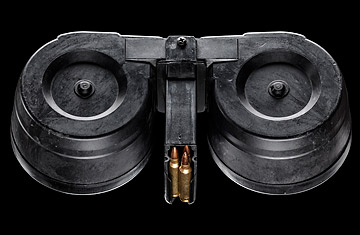
Legislators have tried to ban 100-round ammo-drum magazines similar to the one that was used in Aurora.
(2 of 5)
As Obama seeks re-election, it is legitimate to ask why he and his party have accepted the Republican narrative on this issue--why he is standing "passive in the face of such violence."
The right to bear arms is famously enshrined in the U.S. Constitution. It is also enshrined in the American character, inherent in the chesty, libertarian Scots-Irish sensibility that populated the Appalachian backwoods and spread south and west from there. But no right is absolute. No American has the right to own a stealth bomber or a nuclear weapon. Armor-piercing bullets are forbidden. The question is where you draw a reasonable bright line.
In the early 1990s, after an astonishing rise in violent crime that started in the 1960s and peaked following drug-related gang violence during the 1980s, there seemed to be a critical mass for tighter gun laws. A Gallup poll found 78% in favor of more control. A good part of Bill Clinton's pitch--that he was a "different kind of Democrat"--was predicated on his being tough on crime, unlike previous Democrats who had tilted too far toward the "depraved because they're deprived" view of criminals. Clinton proposed to fund 100,000 new police officers during the 1992 campaign and made good on his pledge with the 1994 crime bill, which also included the assault-weapons ban. The bill was controversial because of the ban and some social-work add-ons like money for urban midnight-basketball leagues to keep kids out of trouble. "I remember the President took a call from [House Speaker] Tom Foley and [majority leader] Dick Gephardt, who said that a lot of their members were scared to death of the gun-control portions of the bill," says William Galston, who served on Clinton's domestic-policy team. "But he stood firm on the ban."
The crime bill passed, 216-214, in the House, but only after Indiana Democrat Andrew Jacobs changed his vote. Jacobs was targeted by the NRA in the 1994 congressional elections but held onto his seat. Others weren't so lucky: 54 House Democrats were expunged that year; Republicans took control of the Senate as well. In the Sun Belt, Republicans routinely ran "3-G" campaigns emphasizing the social issues of God, guns and gays. Clinton attributed 20 of the Democrats' lost seats to NRA targeting. In his autobiography, Clinton wrote that the NRA "could rightly claim to have made Gingrich the House Speaker."
This was immediately accepted as political gospel, but the reality was a bit more complicated. Clinton's own failures, especially his attempt to push health care reform, had a lot to do with the result, as did several of his successes--like his budget plan that raised taxes on the wealthy. "My recollection is that the most important factor [in the rout] was the vote for higher taxes," says Stan Greenberg, who polled for Clinton in 1994. "But the gun issue was crucial in some districts, especially in the South and West."
Clinton had run as a moderate, but he spent his first two years governing like a liberal, or so it seemed in the South. A great many Sun Belt seats that had been redistricted to favor Republicans in 1990 but remained Democratic with Clinton's victory in 1992 were plucked by the GOP in 1994. In any case, it was less painful for Clinton to emphasize the role of the NRA in the election than to acknowledge his mistakes.