

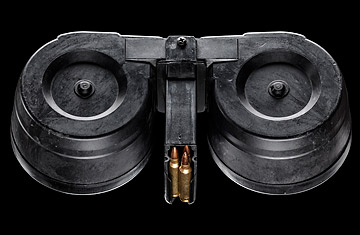
Legislators have tried to ban 100-round ammo-drum magazines similar to the one that was used in Aurora.
(4 of 5)
Indeed, a vote for gun control became more and more difficult as the NRA gained strength over the past 30 years--from 2.4 million members in 1982 to 4.3 million now--and violent-crime rates dropped and guns were transformed into a libertarian-conservative symbol of American freedom by Republican messagemakers. Suddenly GOP candidates began to appear in television ads shooting or toting their weapons. It also didn't help that there was no clear evidence that the assault-weapons ban had accomplished anything. According to Fox's statistics, mass shootings continued, only slightly abated, during the 10 years of the ban. In 2003, the next-to-last year of the law, there were a record 30 shootings, with 135 victims. As support sagged and Democrats abandoned the field, the NRA felt free to become more and more extreme in its advocacy. "I resigned my membership," a Pennsylvania gun owner named Donald Dyke told me recently, "because of all this propaganda they were sending me about President Obama. They're saying that if he's re-elected, he's going to take away all our guns." (And indeed, sales of both handguns and sport rifles have spiked during the first half of 2012 in some regions of the country--Texas, for example--because of the belief that Obama would suddenly change course if re-elected.) But even though Obama has almost no chance to win over the NRA's supporters, he has remained silent on the issue, conforming to the political calculus Kaufman described. Every last vote is going to be crucial in swing states like Ohio, Pennsylvania and Virginia, where gun owners predominate.
By the time that Holmes allegedly opened fire in Aurora, Colo., stricter gun-control measures were opposed by a majority of Americans. And conservatives like George Will could argue, without a twinge of doubt, "The killer in Aurora, Colo., was very intelligent and farsighted and meticulous. I defy you to write a gun-control law that would prevent someone like this with a long time horizon and a great planning capability from getting the arms he wants. I just think that this is a mistake."
Will has a point. Holmes had no record of violence. It was impossible to pick him up with existing background checks. Even if there were an assault-weapons ban, he might have found a way to buy his weapon and perhaps even his 6,000 rounds of ammunition on the black market. There is no law that will prevent every crime. But an assault-weapons ban and a more advanced recording system for ammunition purchases (and perhaps, as Daniel Patrick Moynihan once proposed, a tax on ammunition) might prevent some of these crimes. Not every perpetrator is as smart or meticulous as Holmes allegedly was. Some act out of blind, immediate rage. If the shooter had gone into the theater without a semiautomatic weapon, how many fewer would have been wounded? If only one person had escaped injury, the law would be worth it--as would laws, opposed by civil libertarians, that would make it easier to treat and institutionalize violent paranoid-schizophrenics without their permission. (Such a law might have prevented the Giffords shooting.)