

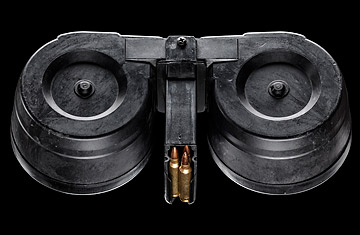
Legislators have tried to ban 100-round ammo-drum magazines similar to the one that was used in Aurora.
(3 of 5)
Even after the 1994 debacle, the Clinton Administration remained devoted to gun control. "The Clinton people didn't run away," recalls Jim Kessler, who served as legislative aide to Congressman (and later Senator) Chuck Schumer, who became the prime sponsor of most gun-control legislation. "We were able to add domestic violence to the list of criminal behaviors that were covered by the Brady Law. There were other small measures that passed with Administration support. And after the Columbine shootings in 1999, Schumer called the White House about pushing the abolition of the gun-show loophole"--which allowed arms to be sold at "private" events without background checks--"and was told, 'That'll be a great issue for Gore. Let's leave it for 2000.'"
Gore ran full bore on gun control after Columbine, even though he'd been pretty quiet about the issue as a Senator from Tennessee. His primary opponent, Bill Bradley, was a vehement gun-control supporter, "and Gore followed Bradley down that road," Kessler recalls. "They tried to outdo each other and both wound up way out in left field--in favor of licensing gun owners and registering guns, restricting purchases to one gun a month. Gore ran for President on the most radical gun-control platform in American history."
When Gore lost, Clinton was out again saying the NRA had beaten him, especially in Arkansas and Tennessee, and that if he, Clinton, had been allowed to campaign in those two states, Gore would have won. "The NRA was certainly a factor," says Elaine Kamarck, who was Gore's domestic-policy adviser during the campaign. "It was so close in so many states. There were a lot of factors. Ralph Nader was a factor. And a 7% drop in support among married women after the Lewinsky scandal didn't help either."
But after the 1994 and 2000 elections, very few Democrats were going to take any chances on gun control. "This is a classic example of the toughest vote any legislator has to make," says Ted Kaufman, who served as Senator Joe Biden's chief of staff and later as his replacement in the Senate. "You have a situation where, say, 60% of your constituents favor something like gun control, but 20% are so adamantly opposed that they won't vote for you even if they agree with you on other issues. Do you just slam the door on that 20%? That's a high-risk proposition."