

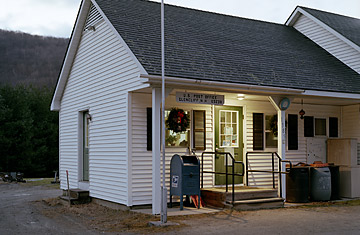
Post Office Closing
Evan Kalish is obsessed with post offices, and he's running out of time.
A grad student at the University of Pennsylvania, he has spent much of the past three years documenting the slow death of an institution that was once at the heart of small-town America--taking photos, collecting postcards, paying tribute. He has crisscrossed the Northeast, driven down South and flown to Hawaii to visit more than 2,700 post offices that are in danger of closing or have already been shuttered. Many of the buildings are historic, some marking the establishment of a community in a growing nation or the revival of a town after a disaster. "The post office helped build the country," Kalish says. "And it's almost like they're trying to destroy themselves."
For weeks, a faded blue-and-white wooden sign from a post office in Malone, Wash., inhabited his apartment, a trophy presented by locals who were grateful for his quixotic mission to save an endangered species. The Malone post office is the only landmark listed if you search for the town on Google Maps. But it closed Aug. 9. The next day, across the street, Red's Hop N' Market began selling stamps and fixed-rate shipping boxes alongside live worms, cigarettes and beef jerky. It became the first "village post office" in the country, part of a strategy that the U.S. Postal Service is counting on to help close a budget gap projected to be more than $14 billion next year.
How did the country's second largest employer (after Walmart), which operates the world's largest fleet of vehicles and handles 40% of the world's mail volume, arrive right at the edge of bankruptcy? A toxic combination of the bad economy, an increase in online bill paying, e-mail and other digital communication, and congressional mandates have created billion-dollar deficits for the USPS since 2007. Last year it lost $8.5 billion. Officials say the Postal Service will run out of money by next August or September, and absent congressional action, it will default on a postponed $5.5 billion retiree payment due Dec. 16, 2011.
And so, emergency measures. On Dec. 5 the USPS announced it would close about half of its nearly 500 mail-processing facilities across the country, which means stamped letters will take at least two days to arrive instead of one. Other cost-cutting proposals involve laying off as many as 100,000 workers, ending Saturday mail delivery and closing thousands more post offices. "If we do nothing," warns Postmaster General Patrick Donahoe, "we will have a death spiral."
But something else will die, counter crusaders like Kalish, who began his mission after collecting stamped postcards for his father on a three-month, solo cross-country road trip. People like Kalish, along with mail-carrier unions, small-town mayors and big corporations, depend on getting their mail from here to there quickly. But for years, the Postal Service hasn't just delivered the mail. It has provided a gathering place for small communities, a hub, a heart, a nerve center--much more than just a wall of mailboxes and windows that sell stamps. "The post office is a foundation piece of democracy," says New York University professor Steve Hutkins, who has been studying the USPS's financial issues. "And it's being treated like a business. But it's not."
Pack Mules and Parachutes