

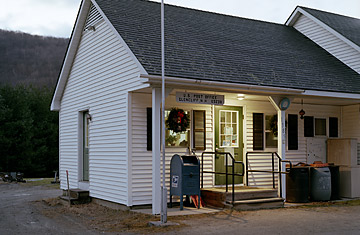
Post Office Closing
(2 of 5)
It wouldn't be far-fetched to argue that the Postal Service has been the most important local institution in our country's history. The Founding Fathers considered it so important that they put it in the Constitution, mandating that Congress have the power to establish post offices. For decades, it was the largest public-sector employer in the U.S. At one point in the 19th century, three-quarters of all government employees were postal workers. In the country's early days, it carried mail by steamboat when no roads existed; it linked California to the rest of the country by delivering mail across the Isthmus of Panama--before the canal was built--using boats, pack animals and canoes.
To this day, the last mile can be an expensive piece of road. Want to send a letter to the Havasupai Indian Reservation at the bottom of the Grand Canyon? The Postal Service will take it there by mule. Need to mail a package to the Alaskan wilderness? The USPS can get it there by parachute. Have to mail something to someplace along Alabama's Magnolia River? The USPS has boats that travel from dock to dock. It has even sent mail via pneumatic tubes, missiles and hovercraft. And somehow, it costs just 44 to get a letter anywhere within the U.S. (Well, 45 starting Jan. 22.)
For decades, this massive operation ran fairly smoothly, expanding along with the country and taking advantage of new technologies brought about by railroad and flight. Mail volume increased from 20 billion pieces in 1947 to 40 billion in 1966. Even so, the USPS's mandate of universal mail access almost ensured that it would go into the red. By the middle of the 20th century, the Postal Service was losing $600 million a year, and that's when the system started to break down.
On the brink of the holiday season in 1966, a sudden influx of advertising mail hit the enormous Chicago main post office (13 stories high, covering 60 acres and billed at the time as the world's largest postal facility). The mail simply stopped. For almost three weeks, 1 million lb. of mail--10 million pieces--barely moved.
The fiasco made two things clear: the institution was vital to the nation's basic functioning, and there was something very wrong with the way it was being run. Postmaster General Larry O'Brien proposed a new Post Office, warning that there were cracks in the system's foundation and that it was close to collapse.
A few years later, in New York City, a wildcat strike broke out, primarily over low wages. At the time, postal workers were making less than sanitation workers, according to Philip Rubio, an assistant professor of history at North Carolina Agricultural and Technical State University. "A postal worker with a family of four could qualify for food stamps," he says.