

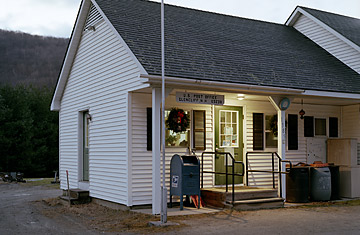
Post Office Closing
(4 of 5)
According to Donahoe, officials are looking at two types of facilities that could be closed: rural post offices that have less than an hour's worth of work a day and urban post offices that generate less than half a million dollars in revenue and are near another post office. To some people, however, shutting down post offices seems not only reckless but also pointless.
"Closing post offices has almost nothing to do with the financial problem that the Postal Service finds itself in today," says Hutkins, founder of SaveThePostOffice.com "The cost of operating these post offices and the amount of money that will be saved by closing them is minuscule in the context of the budget of the Postal Service and the deficit that it's running."
Hutkins teaches courses at NYU on the sense of place and how traveling affects behavior. He got interested in post offices when he heard his branch in Rhinecliff, N.Y., was going to close. What concerns him is not just the loss of an important service but also what he sees as the willful destruction of something that helped build the country. And he thinks postal officials aren't being truthful about it.
By the USPS's calculations, closing all 3,650 post offices that are up for review would save just $200 million, or 2% of the deficit of roughly $10 billion. But it would also eliminate thousands of jobs. "This is a problem I really struggle with because it seems so irrational," Hutkins says. He challenges the way the USPS is explaining the post-office closures to communities, how it uses "emergency suspension" procedures to eventually close post offices that have been damaged by natural disasters, how it's cutting not 100,000 workers but more than 200,000 when attrition is taken into account.
When I asked Donahoe about the post-office closings and whether they amounted to only about 2% of the deficit, he, surprisingly, agreed. "It's pretty close to being accurate," he said. "If you think about it from a $20 billion perspective"--the amount the USPS is trying to cut--"it's about 1% of that. But any other business would do this, and the Postal Service by law is required to do better than break even."
True, any other business might do this, but that's what makes this debate so difficult. The USPS is a quasi-governmental public utility. It's a semiautonomous organization that is only partly private.
"The rhetoric of business is a way to push the Postal Service toward privatization," Hutkins says. "That's ultimately what this is all about. My one theory is they're just penny-wise and pound-foolish, and it may simply be that they're so locked in to the mind-set that if they can save a nickel, that's reason enough to close a post office."
In Philadelphia, one of the locations slated to close is the colonial-themed B. Free Franklin post office. It doesn't fly a flag because mail delivery was established before the nation was founded. It uses a unique postmark featuring a franking technique used by Franklin. And the fact that it's on the list of post offices scheduled to close is stirring up sadness and anger in those who love the historic location.
I asked Donahoe what sort of advice Franklin, the first Postmaster General, might give his successor today. "I think that Benjamin would probably say, 'Don't be penny-wise and pound-foolish.'"