

Post Office Closing
(3 of 5)
When the workers walked out, President Richard Nixon sent in National Guard and U.S. Army troops to try to sort the mail. But it didn't help. The mail kept stacking up, and Nixon soon realized he needed to negotiate. Thus was born the Kappel Commission, a presidential advisory group made up of corporate leaders who had, admittedly, little knowledge about mail-delivery operations. By 1970 they were at work on proposals to reform the mail service. These eventually became the Postal Reorganization Act, turning the U.S. Post Office Department into the U.S. Postal Service. But it was more than just a name change. Congress essentially turned the Postal Service into a quasi-governmental organization--not really a business but not really part of the government either. It was being forced to run more like a private entity, to be self-supporting, even as it was tasked to maintain service to every American home. And for the first time, workers were given full collective-bargaining rights.
For the next several decades, the USPS was successful by most measures, while surviving outbursts from the occasional disgruntled worker--incidents that brought the phrase going postal into the national consciousness. And of course, there were some perennially angry customers fed up with long lines. But in general, the USPS was doing well enough that Congress decided it should start prefunding its retiree accounts--for the next 75 years. In 2006, Congress passed a law requiring an annual prepayment of retiree health benefits to the tune of $5.5 billion or more a year for 10 years. Except Washington didn't see the recession coming. "That act has left such a devastating legacy that it threatens to drive our nation's Postal Service off the rails," Rubio says.
Penny-Wise and Pound-Foolish?
Enter Patrick Donahoe, the 55-year-old Pennsylvanian who became the nation's 73rd Postmaster General in October 2010, perhaps the rockiest time in the service's history. Donahoe has worked at the Postal Service for 36 years, first as a clerk in his hometown, Pittsburgh. He eventually worked his way up to the office that Pennsylvania's Benjamin Franklin once held. "I'm an antique," he jokes.
Donahoe calmly laid out his plans to pull the service back from the brink: reducing costs by $20 billion through 2014, pushing Congress to approve five-day rather than six-day delivery and laying off tens of thousands of workers.
If things weren't bad enough, the USPS is increasingly relying on junk-mail revenue, which has grown significantly in the past couple of years. "I love the term junk mail," Donahoe says sarcastically. "If you work in the Postal Service, it's jobs mail. The interesting thing about that is, direct mail has probably got the best return on investment of any kind of advertisement." That means, expect even more junk mail in the future.
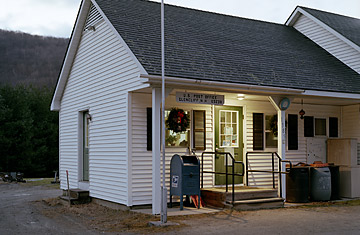
What really has people riled up is the number of planned post-office closures. So far, the USPS has placed almost 3,700 post offices on a review list, but that's not the end of it. "We'll probably look at 15,000 post offices rather than just 3,700," Donahoe says. "Not to say that anything is guaranteed to close, but if you're spending $70,000 to operate a place that's bringing in $10,000, there have to be some other solutions."