

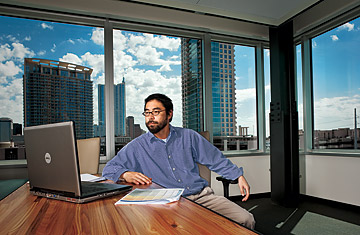
Michael Kim landed his job as HomeAway expands to meet growing demand for its online house-rental service.
(7 of 9)
In northwest Austin, in cubicles packed with toys and rock-band posters, people in T-shirts and jeans are hard at work creating a video game that someday will be played online by thousands of people at a time. It takes years to produce such a complex game, representing a major investment for California-based Electronic Arts. Why is this happening in Austin? Simple. "The talent pool is here," says local BioWare studio co-head Gordon Walton.
In the national job-creation discourse, jobs often start to sound like things that companies one day decide to hand out. In reality, job creation is also a function of the labor supply. It's not just about firms wanting to hire but also about having people they can usefully employ. There are only four or five cities in the U.S. where Electronic Arts would be likely to develop such a complicated product. Austin is one of them partly because it has a tech-savvy population and a history of fielding such work--and also because it's an easy place for people to train for the profession, with local colleges offering courses in game design and programming.
In a down economy, plenty of people assume responsibility for reinvention. Lindsey Spratt lost her job as an assistant audio engineer and is now studying to be a chef at the Texas Culinary Academy. Rob Carruthers was laid off from a job as a project manager at a software company and is putting his dual engineering-business background to use as a consultant to tech start-ups and schools.
Austin also illustrates a systematic approach to making sure people have the right skills to match what companies need. For the past two years, Workforce Solutions, a government-funded not-for-profit, has been partnering with businesses and local schools like Austin Community College to develop a series of training courses to help people upgrade their skills and earn certifications. The modules are built to be accessible to people well into their careers--recognizing that a 40-year-old isn't likely to have two or four years to return to school full time--and focus on Austin's up-and-coming industries, like biotech, renewable energy and video-game development. "When these jobs come, we'll have the people with the skills to move into them," says Workforce executive director Alan Miller.
Employers are stepping up too. A few blocks east of the state capitol stands a hospital, one of 10 in the metro area owned and run by the not-for-profit Seton Family of Hospitals. An adjacent building that used to be a children's hospital now houses a clinical-education center. Wards and operating rooms are filled with patients--sophisticated, computer-controlled dummies that nurses-to-be can use to receive valuable training. One dummy even gives birth.
Health care as an industry is booming in most places, and Austin is no exception. Over the past three years, Seton has built three medical centers and hired 2,300 people. But getting people into those jobs--nearly 30% of which are for nurses--is a multipronged process. A few years ago, there was a waiting list to enter nursing school in Austin. Seton had to hire nurses trained in the Philippines. Now, with the clinical-education center's extra capacity and new partnerships with nursing programs at local colleges, Seton can hire locally.