

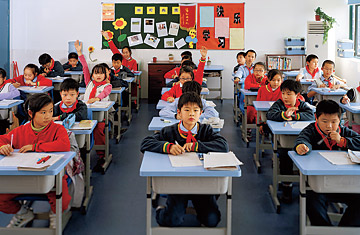
China's schools are adding more creative and practical topics to their notoriously rigid curriculum.
(6 of 8)
Home care for the elderly will most likely make a comeback in the U.S. out of sheer economic necessity, however. The number of elderly Americans will soar from 38.6 million in 2007 to 71.5 million in 2030. But, says Arnold Eppel, who recently retired as head of the department of aging in Baltimore County, Maryland, "There won't be enough spots for them" in the country's overwhelmed nursing-home system. Appreciating the magnitude of the coming crisis, the U.S. government has begun to respond. Two new initiatives--Nursing Home Diversion and Money Follows the Person--expand subsidies for home elder care, and the Veterans Health Administration has just put in effect its own similar initiative. "The whole trend will be into home care, because nursing homes are too expensive," Eppel says, noting that nursing-home care in the U.S. costs about $85,000 annually per resident.
In China, senior-care costs are, for the most part, borne by families. For millions of poor Chinese, that's a burden as well as a responsibility, and it unquestionably skews both spending and saving patterns in ways that China needs to change (see Save More, below). For middle-class and rich Chinese, those costs are a more manageable responsibility but one that nonetheless ripples through their economic decision-making. Still, there are benefits that balance the financial hardship: grandparents tutor young children while Mom and Dad work; they acculturate the youngest generation to the values of family and nation; they provide a sense of cultural continuity that helps bind a society. China needs to make obvious changes to its elder-care system as it becomes a wealthier society, but as millions of U.S. families make the brutal decision about whether to send aging parents into nursing homes, a bigger dose of the Chinese ethos may well be returning to America.
LESSON
4
Save More
You've now heard it so many times, you can probably repeat it in your sleep. President Obama will no doubt make the point publicly when he gets to Beijing: the Chinese need to spend more; they need to consume more; they need--believe it or not--to become more like Americans, for the sake of the global economy.
And it's all true. But the other side of that equation is that the U.S. needs to save more. For the moment, American households actually are doing so. After the personal-savings rate dipped to zero in 2005, the shock of the economic crisis last year prompted people to snap shut their wallets. Now that it's pouring, in other words, American households have decided to save for a rainy day. The savings rate is currently about 4% and has gone as high as 6% this year.
In China, the household-savings rate exceeds 20%. It is partly for straightforward policy reasons. As we've seen, wage earners are expected to care for not only their children but also their aging parents. And there is, to date, only the flimsiest of publicly funded health care and pension systems, which increases incentives for individuals to save while they are working. But China, like many other East Asian countries, is a society that has esteemed personal financial prudence for centuries. There is no chance that will change anytime soon, even if the government creates a better social safety net and successfully encourages greater consumer spending.