

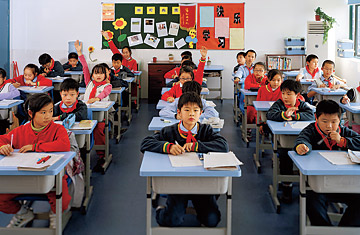
China's schools are adding more creative and practical topics to their notoriously rigid curriculum.
(4 of 8)
A lot of foreigners--and, indeed, a fair number of Chinese--believe that the obsession (and that's the right word) with education in China is overdone. The system stresses rote memorization. It drives kids crazy--aren't 7-year-olds supposed to have fun on Saturday afternoons?--and doesn't necessarily prepare them, economically speaking, for the job market or, emotionally speaking, for adulthood. Add to that the fact that the system, while incredibly competitive, has become corrupt.
All true--and all, for the most part, beside the point. After decades of investment in an educational system that reaches the remotest peasant villages, the literacy rate in China is now over 90%. (The U.S.'s is 86%.) And in urban China, in particular, students don't just learn to read. They learn math. They learn science. As William McCahill, a former deputy chief of mission in the U.S. embassy in Beijing, says, "Fundamentally, they are getting the basics right, particularly in math and science. We need to do the same. Their kids are often ahead of ours."
What the Chinese can teach are verities, home truths that have started to make a comeback in the U.S. but that could still use a push. The Chinese understand that there is no substitute for putting in the hours and doing the work. And more than anything else, the kids in China do lots of work. In the U.S., according to a 2007 survey by the Department of Education, 37% of 10th-graders in 2002 spent more than 10 hours on homework each week. That's not bad; in fact, it's much better than it used to be (in 1980 a mere 7% of kids did that much work at home each week). But Chinese students, according to a 2006 report by the Asia Society, spend twice as many hours doing homework as do their U.S. peers.
Part of the reason is family involvement. Consider Liu, the 7-year-old who had to leave the birthday party to go to Saturday school. Both his parents work, so when he goes home each day, his grandparents are there to greet him and put him through his after-school paces. His mother says simply, "This is normal. All his classmates work like this after school.''
Yes, big corporate employers in China will tell you the best students coming out of U.S. universities are just as bright as and, generally speaking, far more creative than their counterparts from China's élite universities. But the big hump in the bell curve--the majority of the school-age population--matters a lot for the economic health of countries. Simply put, the more smart, well-educated people there are--of the sort that hard work creates--the more economies (and companies) benefit. Remember what venture capitalist Tam said about China and the electric-vehicle industry. A single, relatively new company working on developing an electric-car battery--BYD Co.--employs an astounding 10,000 engineers.