

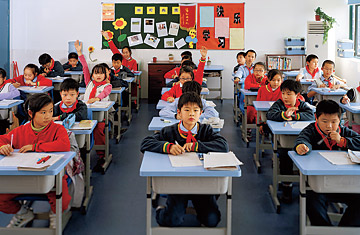
China's schools are adding more creative and practical topics to their notoriously rigid curriculum.
(2 of 8)
Some economists believe that given its stage of development, China spends too much on expensive items like high-speed rail lines. But step back from the individual infrastructure projects and the debates about whether a given investment is necessary, and what's palpable in China is the sense of forward motion, of energy. No foreigner--at least not one I've met in five years of living here--even bothers denying it. And the Chinese take it for granted. When a brand-new six-lane highway opened in suburban Shanghai in October, Zhong Li Ping, who shuttles migrant workers to the city and back to their hometowns, said, "I don't know what took them so long." In truth, it took about two years--roughly the time it would take to get the environmental and other regulatory permits for a new highway in the U.S. If, that is, you could get them at all.
There's no direct translation into Chinese of the phrase can-do spirit. But yong wang zhi qian probably suffices. Literally, it means "march forward courageously." China has--and has had for years now--a can-do spirit that's unmistakable. Americans know the phrase well. They invented it. It used to define them.
Critics of the authoritarian Chinese government would say it's a system more accurately called "can do--or else." And they have a point. No one in the U.S. would argue that it should adopt China's dictatorial style of government. America doesn't need to displace tens of thousands of people in order to build a massive dam, as China did in Hubei province from 1994 to 2006. (The value of checks and balances is, in fact, among the many things China could learn from the U.S.) But you don't have to be a card-carrying communist to wonder how effectively the U.S. develops and executes ambitious projects. Ask James McGregor. He's a former chairman of the American Chamber of Commerce in China and now a business consultant who divides his time between the two countries. "One key thing we can learn from China is setting goals, making plans and focusing on moving the country ahead as a nation," he says. "These guys have taken the old five-year plans and stood them on their head. Instead of deciding which factory gets which raw materials, which products are made, how they are priced and where they are sold, their planning now consists of 'How do we build a world-class silicon-chip industry in five years? How do we become a global player in car-manufacturing?'"