

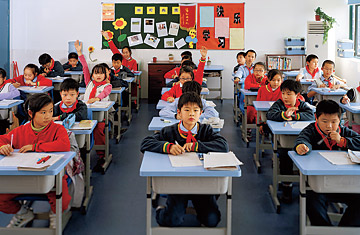
China's schools are adding more creative and practical topics to their notoriously rigid curriculum.
On the evening of Nov. 15, President Barack Obama, the youthful leader of one of the world's youngest countries, begins his first visit to China, among the world's most ancient societies. Obama and his Chinese counterpart, Hu Jintao, have much to discuss. Nukes in Iran and North Korea. China's surging military spending. Trade imbalances. Climate change.
But the visit comes at an awkward moment for the U.S. China, despite its 5,000-year burden of history, has emerged as a dynamo of optimism, experimentation and growth. It has defied the global economic slump, and the sense that it's the world's ascendant power has never been stronger. The U.S., by contrast, seems suddenly older and frailer. America's national mood is still in a funk, its economy foundering, its red-vs.-blue politics as rancorous as ever. The U.S. may be one of the world's oldest capitalist countries and China one of the youngest, but you couldn't blame Obama if he leaned over to Hu at some point and asked, "What are you guys doing right?"
Could the world's lone but weary superpower actually learn something from China? It's a politically incorrect question, of course. China is an authoritarian nation; its ruling Communist Party deals ruthlessly with any challenge to its hegemony. It remains, relatively speaking, a poor, developing country with huge problems to confront, massive corruption and environmental degradation being Nos. 1 and 1a. Still, this is a moment of humility for the U.S., and China is doing some important things right. If the U.S. were to ask the Chinese what it could learn from their example, it might gain some insight into what it's doing right and wrong. Here are five lessons from China's success story:
LESSON
1
Be Ambitious
One day this summer, Sean Maloney, an executive vice president at Intel, was bouncing from one appointment to another in northeastern China, speeding along in a van traversing newly built highways. He gazed out at one of the world's biggest construction projects: a network of high-speed train lines--covering 10,000 miles (16,000 km) nationwide--that China is building. As far as the eye could see, there sat vast concrete support struts, one after another, exactly 246 ft. (75 m) apart. Each was full of steel cables and weighed about 800 tons. "We used to build stuff too," Maloney mused, unprompted. "But now it's NIMBY [not in my backyard] every time you try to do something. Here,'' he joked, "it's more like IMBY. There's stuff happening here, everywhere and always."
It's not just NIMBYism that constrains the U.S. these days, of course. America is close to tapped out financially, with budget deficits this year and next exceeding $1 trillion and forecast to remain above $500 billion through 2019. But sometimes the country seems tapped out in terms of vision and investment for the future.