

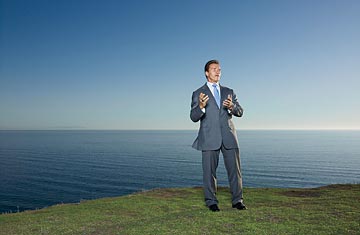
Governor Arnold Schwarzenegger laughs off the California-is-over drama: "It's all bogus."
(5 of 7)
Guido Jouret, who oversees Cisco's emerging technologies, explained this creative destruction when we talked over TelePresence, an ultra-high-definition substitute for the hassle, expense and carbon footprint of business travel. We were 3,000 miles (4,800 km) apart, but I kept forgetting we weren't at the same conference table. One of Steven Spielberg's cinematographers helped Cisco get the illusion of intimacy just right. "California has a very welcoming attitude, but it's a Darwinian society," Jouret said. "Companies come and grow and die, and no one sheds a tear. And there's a real sense that it isn't worth doing if it won't change the world."
California's high-tech community has concluded en masse that the next Google guys are going to be the visionaries who figure out how to harness the sun, build a battery to store the wind or engineer the renewable fuel that won't compete with the food supply. (It could be the actual Google guys, who have launched an aggressive clean-energy initiative.) "Inventing a better gadget isn't enough anymore. We're trying to reshape the way people live," says SolarCity CEO Lyndon Rive, a South African who went to California for the world underwater-hockey championships, got caught up in the Internet boom and never left. He built and sold an IT-support company; now he's reshaping its software to monitor solar panels.
The State of Progress
So why all the end-is-nighism? Schwarzenegger thinks California gets slagged nationwide for the same reason the U.S. gets slagged worldwide: it's natural to resent the big kahuna. (He should know; his approval rating has dipped below 30%.) In a poolside interview after hosting a global climate summit in Century City, he suggested that outsiders envy California's immense resources--beaches, mountains and redwoods; Hollywood, Napa and Disneyland; the best in stem-cell research, fruits and vegetables, entertainment and fashion. (He was sporting a suit with a zebra-print lining.) "We're all about the cutting edge," he said. "I mean, come on. California is wild!" He's right about the schadenfreude, and it was fun to hear him say the word. It is easy to gloat when the cool jock with the hot girlfriend wrecks his sweet car, especially if he seems kind of smug. I was reminded of this during Rob Lowe's talk at the summit, when he declared that everyone has an obligation to join the fight against global warming, then continued, "For my part, I'll be doing The Ellen DeGeneres Show."
Then again, California has legitimate problems that inspire legitimate criticism: gangs, sprawl, disturbing dropout rates, water shortages that don't seem to stop farmers from irrigating rice and cotton in the desert, the crazymaking traffic that Hollywood immortalized in Falling Down. It's still sitting on a fault line. Its expensive housing, even after the real estate crash, poses a real obstacle to the dream of upward mobility. So do its public schools and other public services, which have been deteriorating for years--in part because older white voters have been reluctant to subsidize younger minorities.