

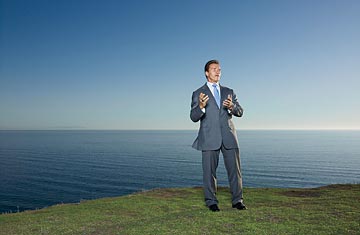
Governor Arnold Schwarzenegger laughs off the California-is-over drama: "It's all bogus."
(2 of 7)
It can be perilous to generalize about a place this gigantic, an overwhelmingly metropolitan state that leads the nation in agricultural production, a majority-minority state with a white-majority electorate. There are real differences between (crunchy, techy) Northern and (hipster, surfer) Southern California, and especially (richer, denser, bluer) coastal and (poorer, sparser, redder) inland California. But one generalization has held true from the Gold Rush to the human-potential movement to the dotcom boom: California stands for change, for disruption of the status quo. "California is not another American state," concluded Carey McWilliams in his 1949 history California: The Great Exception. "It is a revolution within the states."
Today, it's still the home of the new new thing. It is electric-vehicle start-ups like Tesla, Fisker and Better Place taking on the Big Three, or the local-organic foodies behind California cuisine going after Big Ag. It's Kaiser Permanente, the HMO whose model of salaried doctors in group practice may be the future of health care, or the University of California at Irvine's law school, which opened this semester with free tuition and was instantly more selective than Harvard or Yale. It's SpaceX, the private rocket-launching company, or Kogi, the Korean taco truck that announces its location over Twitter to flash mobs of Angelenos. "The beauty of California is the idea that you can reinvent yourself and do something totally creative," says Kogi's Roy Choi, a former chef at the Beverly Hilton. "It's still the Wild West that way."
California is a state of early adopters--not only in fashion, technology and design but in politics too. Its voters approved huge bonds for stem-cell research, high-speed rail and repairs to aging infrastructure while Washington was dragging its feet; its politicians adopted first-in-the-nation greenhouse-gas regulations, green building codes and efficiency standards for automobiles and appliances that have rearranged the national energy debate. Yes, it was also an early adopter of subprime mortgages--Countrywide, Golden West and IndyMac were all California-based--but life on the frontier has always been risky. "This is the most dynamic place for change on earth," genomic pioneer J. Craig Venter said on a recent tour of his San Diego labs, where researchers are studying ways to convert algae into oil, coal into natural gas and human wastewater into electricity. "That's why we're here." Dressed in shorts, flip-flops and a crazy-loud floral shirt on a typically perfect day, Venter noted that California's quality of life isn't bad either: "It is pretty nice not to have to wear pants."