

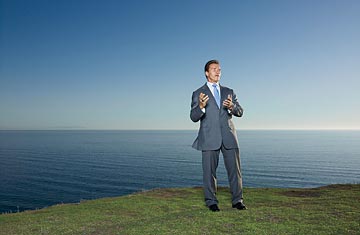
Governor Arnold Schwarzenegger laughs off the California-is-over drama: "It's all bogus."
(4 of 7)
California has been preparing for its clean-energy future for a long time. Starting in the energy crisis of the 1970s, California revamped its electricity markets so that utilities could make more money by helping their customers use less power. It also began enacting groundbreaking efficiency standards for buildings, appliances, pool heaters and almost anything else that needs juice. It just proposed the first standards for flat-screen TVs. As a result, per capita energy use has remained stable in California while soaring 50% nationwide, saving Californians an estimated $56 billion and avoiding the need for 24 new gas-fired power plants. On the supply side, the state has required utilities to provide one-fifth of their power from renewables by 2010, which will jump to one-third by 2020. And California's soup-to-nuts effort to slash emissions--including a cap-and-trade regimen in 2012--is the blueprint for federal climate legislation.
This public-sector foresight has created alluring opportunities for the most tech-savvy private sector on earth. The venture capitalists behind the high-tech and biotech booms see clean tech as the next big score. The necessary engineers, scientists, accountants, lawyers, marketers and other knowledge workers are already there. "We've already turned industries on their heads, so we assume we can do it again," says Steve Dolezalek, VantagePoint Venture Partners' managing director, who oversaw the firm's software and life-sciences investments before heading its clean-tech group.
The lines between sectors are blurring fast. As its name suggests, eSolar is essentially a software play; its added value is advanced code that positions vast arrays of mirrors to the millimeter to maximize their exposure to sunlight. The company was spawned by IdeaLab, a Pasadena incubator that developed NetZero, Picasa, pay-per-click ads and online car-selling. "We only do ideas that challenge the status quo, and California is the only place we'd do it," says CEO Bill Gross.
Chip-industry veterans are also drifting into solar, as well as LED lighting and green materials, while Cisco, which made the guts of the Internet, is pivoting to make the guts of the digitized grid. San Diego's cluster of more than 500 biotech companies is now the world capital of algae-to-fuel experiments, including a new $600 million joint venture between ExxonMobil and Venter's Synthetic Genomics. Khosla's investments include Calera, a carbon-capturing-cement start-up founded by a Stanford expert in medical cement; Amyris, which has Berkeley malaria researchers working to turn sugar into diesel; and Soladigm, which exploits semiconductor-industry expertise to make energy-efficient windows.
California scores poorly in most "business friendly" ratings, which tend to focus on tax rates and wage levels rather than on, say, worker productivity or creativity. And the state has more than its share of no-no-no types protesting nanotechnology, synthetic biology and even some SunPower solar-energy projects, which could possibly imperil kangaroo rats and fairy shrimp. But the state's business culture fetishizes long-shot ventures and game-changing ideas. Failure is appreciated, not stigmatized, and an entrepreneur without a few busted start-ups on his résumé is almost suspect.