

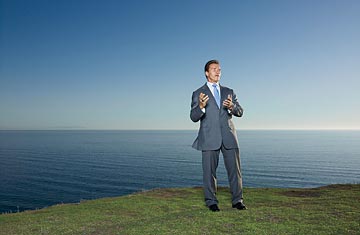
Governor Arnold Schwarzenegger laughs off the California-is-over drama: "It's all bogus."
California, you may have heard, is an apocalyptic mess of raging wildfires, soaring unemployment, mass foreclosures and political paralysis. It's dysfunctional. It's ungovernable. Its bond rating is barely above junk. It's so broke, it had to hand out IOUs while its leaders debated how many prisoners to release and parks to close. Nevada aired ads mocking California's business climate to lure its entrepreneurs. The media portray California as a noir fantasyland of overcrowded schools, perpetual droughts, celebrity breakdowns, illegal immigration, hellish congestion and general malaise, captured in headlines like MELTDOWN ON THE OCEAN and CALIFORNIA'S WIPEOUT ECONOMY and WILL CALIFORNIA BECOME AMERICA'S FIRST FAILED STATE?
Actually, it won't.
Ignore the California whinery. It's still a dream state. In fact, the pioneering megastate that gave us microchips, freeways, blue jeans, tax revolts, extreme sports, energy efficiency, health clubs, Google searches, Craigslist, iPhones and the Hollywood vision of success is still the cutting edge of the American future--economically, environmentally, demographically, culturally and maybe politically. It's the greenest and most diverse state, the most globalized in general and most Asia-oriented in particular at a time when the world is heading in all those directions. It's also an unparalleled engine of innovation, the mecca of high tech, biotech and now clean tech. In 2008, California's wipeout economy attracted more venture capital than the rest of the nation combined. Somehow its supposedly hostile business climate has nurtured Google, Apple, Hewlett-Packard, Facebook, Twitter, Disney, Cisco, Intel, eBay, YouTube, MySpace, the Gap and countless other companies that drive the way we live.
"Whenever we have a problem, everyone makes a big drama--'Oh, my God, it's the end. California is over,'" Governor Arnold Schwarzenegger told me. "It's all bogus." Schwarzenegger likes spin and drama too--he's issued warnings about a "financial Armageddon"--and he literally blew smoke in my eyes while we spoke. But his belief in the anything-is-possible dream of California is more than spin; he is, after all, its ultimate embodiment.
California, to borrow a phrase, will be back. It's been stuck in an awful recession--not quite as awful as Nevada's--but it's getting unstuck. It's made nasty cuts to close ugly deficits, but it hasn't had to release prisoners or close parks, and its IOUs are being paid. Its businesses aren't fleeing to Nevada or anywhere else; Jed Kolko, an economist at the Public Policy Institute of California, has shown that fewer than one-tenth of 1% of its jobs leave the state each year. Even California's real problems tend to get magnified by its size. If it were a country, it would be in the G-8. So, yes, California has the most foreclosures and layoffs. With 38 million residents and a $1.8 trillion economy, it also has by far the most homes and jobs.