

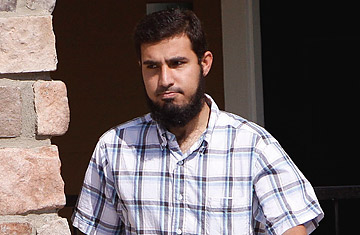
Najibullah Zazi
(6 of 6)
On Sept. 6, Zazi returned to the kitchenette for another night over the stove, punctuated by frantic calls to still unknown accomplices seeking bombmaking advice. On Sept. 8, he rented a car, arranging to drop it off in New York City. At that point, the investigation "amped up" again, the intelligence official says, as agents asked themselves the obvious question, "What does he have in his car that he can't put in an airplane? And who's waiting on the other end?" The timing was alarming: the eighth anniversary of 9/11 loomed, and Obama was due in Manhattan days later. Still, the feds didn't move to arrest Zazi: "We saw him as a possible plotter, a possible actor and a possible intelligence-collecting platform--someone who could lead us to a picture or a wider network."
As the alleged bomber set out for New York City on Sept. 9, the FBI drew the New York Police Department into the investigation, and NYPD detectives showed pictures of Zazi and three suspected accomplices to an imam they had developed as a possible informant. Sure enough, the imam, Ahmad Afzali, recognized Zazi. But according to the FBI, he called Zazi and his father to tell them of the NYPD's inquiries. And that was that. Zazi reached New York City just as the investigation was blowing up.
A flurry of search warrants and interrogations quickly followed. In Zazi's rental car, agents allegedly found a laptop containing nine pages of bombmaking instructions. Zazi returned to Denver and volunteered for FBI interviews; when he stopped cooperating, he was arrested, initially for giving false statements. He was indicted on Sept. 24 for "conspiracy to use weapons of mass destruction." Beyond that, it's unclear where the evidence stands. Have bombs been found? Are the targets known? How close was Zazi to taking action? Will other suspects be charged? Officials aren't saying. The picture "will get clearer as time goes on," the intelligence official promises.
Needles in Haystacks
If Zazi represents a new kind of menace for the U.S., his arrest could be a double blessing, a counterterrorism official offers. Not only did it thwart a plot but it could also lead to a mother lode of information on al-Qaeda, the Taliban and the state of the global jihad. But there are other, less reassuring lessons from Zazi and from the alleged lone-wolf wannabe terrorists snared by the FBI in Texas and Illinois. For starters: hatred is patient. The American struggle against Islamic terrorism, already one of the longest wars in the nation's history, is not winding down. The longer it goes on, the more likely that the enemy will try to find new fronts closer to home. The hard debates over the use of force, surveillance tactics, interrogation methods and the rights of terrorists have many chapters yet to be written. Aurora Mayor Ed Tauer puts the idea slightly differently: "The lesson is that even if you don't see yourself as one of those high-visibility targets, you can wake up to find a terrorist down the block."
Out in Aurora, the feds may have found a needle in a haystack. But how many are in the process of disappearing right now? How much more should be done to find them? And how long will it be before one of them jabs us again?
Zazi in Aurora
To see more photos of Najibullah Zazi's life in Colorado, go to time.com/zazi