

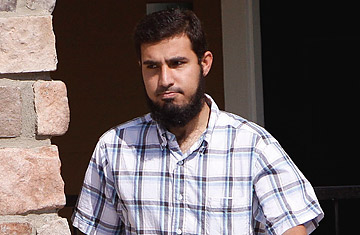
Najibullah Zazi
(2 of 6)
Zazi's story begins 24 years ago, in the midst of a war in Afghanistan's Paktia province, a violent region of jagged mountains, ominous caves and boulder-strewn ravines. The war pitted U.S.-backed Islamic fundamentalists against troops of the Soviet occupation. Little is known of Zazi's childhood, but around the time he was born, there was a newcomer in Paktia: a zealous Saudi millionaire named Osama bin Laden. He had come to see jihad in action, and he was thrilled and inspired by the experience of combat. Bin Laden built mosques and schools on both sides of the border with Pakistan, but he was a warrior at heart. So he decided to attract his own army and construct a fortress for the jihad. He chose a site near the tribal village of Jaji. Using bulldozers and explosives, bin Laden connected some 500 mountain caves into a network of underground rooms. He called the place al-Masada, or the Lion's Den--and he was the lion. There, in the spring of 1987, the mujahedin repelled attacks by élite Soviet troops backed by bomber jets and pro-Soviet Afghan fighters. Victory in the Battle of Jaji, during which bin Laden may have been wounded, became the cradle of Osama's myth. A generation later, halfway around the world, we are still living with the consequences.
It's easy to imagine that a little boy growing up in Paktia province might have heard heroic tales of the Battle of Jaji and its hero, bin Laden. When Zazi was about 7 years old, his father moved the family across the border into Pakistan, near Peshawar, another zone of bin Laden influence and a hotbed of jihadist activity.
The father, Mohammed Wali Zazi, eventually immigrated to New York City, where he found work as a taxi driver, saving his money until he had enough to bring his wife and children to the U.S. (The older Zazi became a naturalized U.S. citizen.) Once in New York City, Najibullah proved to be an indifferent student at Flushing High School in Queens, more interested in basketball than in books, and he was a silent watcher at the Hazrat-i-Abubakr Sadiq mosque. His imam in those days, Mohammed Sherzad, remembers Zazi's visits to the white two-story building topped with a blue dome and minaret: "Every Saturday and Sunday, I had a class for the younger generation. Some students would ask me questions, but Najibullah never asked--he was listening."
When Zazi was 16, bin Laden's army delivered a stunning attack on New York City and Washington. The destruction of the World Trade Center towers drove a wedge into the community of Afghan immigrants in Queens, Sherzad recalls, and the mosque was torn apart over the imam's criticism of the Taliban government that shielded bin Laden in Afghanistan. The Zazi family sided against Sherzad, he recalls, and afterward Zazi refused to meet the imam's gaze when they passed each other on the street. Still, an acquaintance told the New York Times that Zazi was baffled by the suicide hijackers. "I don't know how people could do things like this," Zazi reportedly said of the attacks. "I'd never do anything like that."