

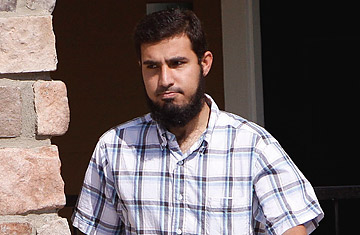
Najibullah Zazi
(4 of 6)
Why did Zazi take this step? "It's sometimes difficult to determine exactly at what point it was that somebody becomes radicalized and then decides to become a terrorist," a senior Obama Administration official tells TIME. "Usually it's an evolutionary process." And what does it mean to have an Afghan immigrant take up al-Qaeda's cause? The worst-case scenario, according to experts, is that Zazi may represent an effort by the Taliban to expand its attacks on U.S. interests. Robert Grenier, a former CIA station chief in Pakistan, believes the Taliban's worldview has changed since the U.S.-led invasion ousted it from power in late 2001. "Many of the leaders now see themselves as part of the global jihad," says Grenier, who heads the consulting firm ERG Partners. "Lots of Afghans see the U.S. presence as an occupation, and I can easily see how some of them would be motivated to strike at the U.S. wherever they can." If Grenier is right and the Taliban has joined al-Qaeda in taking the fight beyond central Asia, Western authorities will need to widen the scope of their operations at home and abroad. "If he's Taliban, then it greatly expands the universe of people you want to put under surveillance," says Bill Rosenau, a counterterrorism expert at the Rand Corp.
This much is clear: when Zazi returned to the U.S. in January of this year, law-enforcement agencies began keeping track of him.
The Manhunt
Triacetone triperoxide (TATP) is a notoriously unstable chemical compound known among Palestinian militants as umm shaitan, or the mother of Satan. Many would-be bombmakers have suffered severe burns while trying to mix the explosive in makeshift laboratories. For terrorist groups, however, the risks of TATP are outweighed by the advantages. The white, sugarlike powder is lightweight and nearly odorless (the better to evade bomb-sniffing dogs) and contains no nitrogen (foiling scanners that detect nitrogenous bombs). Its basic ingredients--acetone, hydrogen peroxide and acid--are readily available in beauty supplies and home-improvement products. Al-Qaeda operatives have been using the stuff for years.
After his bomb training in Pakistan, Zazi returned to New York City and then moved to Aurora, joining relatives in a house on East Ontario Drive, a few doors down from the chief of police. Why Aurora? The answer may be as simple as the low cost of living, the presence of a few relatives and the familiar terrain. The dry plains, thin air and faraway peaks bear no small resemblance to northern Pakistan and Paktia province. Zazi passed a background check to qualify as an airport-shuttle driver, and if he was notable for anything, it was his appetite for work. Other drivers describe his recruiting customers while standing in front of a white van bearing the company's name--First ABC Transportation Inc. Unlike most drivers at ABC, who pulled eight- or nine-hour shifts, Zazi routinely put in 16-to-18-hour days, sometimes 80 hours a week. "He was a regular kind of guy, but he worked hard, and he wanted money," says Hicham Semmaml, a Moroccan-born driver for ABC. When he was not working, Zazi occasionally attended the Colorado Muslim Society mosque, a moderate, friendly place light-years from the radical mosques built by bin Laden in Pakistan.