

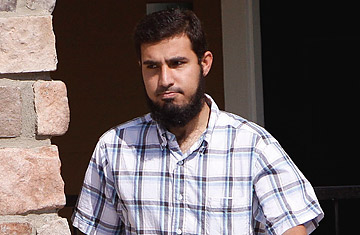
Najibullah Zazi
You'd think Najibullah Zazi would stand out on the high, dry plains southeast of Denver, where the earth is as flat as a starched shirt and mere wrinkles count as topography. But if heartland suburbs were ever enclaves of uniformity, that day is long gone. Aurora, Colo., is a city of people from somewhere else, a low-slung municipality of 315,000 that includes extremes of both poverty and prosperity. Aurora is vast--nearly 154 sq. mi. (400 sq km)--and dense, with a high concentration of multifamily housing units, apartment buildings, townhouses and condominiums. Those homes contain a patchwork of races, ethnicities and tribes: Aurora is 23% Hispanic; 13% black; 15% Asian, Native American and other. Nearly 100 languages are spoken by students in the Aurora public schools. It is, in short, an excellent place for a young man with a laptop and a recipe for bombs to hide in plain sight.
Even while allegedly buying gallons of chemicals at beauty-supply shops and renting a cheap hotel suite to cook them in, Zazi might have remained anonymous long enough to strike and kill, except that U.S. Homeland Security is a sharper instrument than it was in the summer of 2001. The dysfunctional system that failed to connect the dots before 9/11 managed, eight years later, to spot and disrupt a plot in progress. Zazi has denied charges he conspired to bomb targets in the U.S., but government officials are confident they've got their man. Authorities took notice when Zazi traveled last year to Pakistan, while his unsavory associations there--the FBI charges that Zazi attended terrorist training camps--heightened their interest. The government caught Zazi about a month ago talking about chemicals on his cell phone. From then on, virtually the entire FBI Denver field office was on his trail.
That's the good news. Perhaps the fact that he was caught in time--and the same week that two other alleged bombing attempts were foiled in Middle America--tells us that post-9/11 security measures, many of them highly controversial, are working. But there is bad news too. Zazi's alleged project, from the training camp in Pakistan to his bomb recipe and backpack delivery system, bears the marks not of some fluky local scheme of the kind that the feds have sniffed out in the past but of a plausible al-Qaeda operation. Nor does Zazi appear to be a lone sympathizer or a copycat egged on by an FBI informant. He apparently had marching orders, accomplices and a quiet determination to deliver a stunning blow. In all these respects, Zazi resembles the al-Qaeda bombers who attacked the London subway in 2005. Indeed, if the charges against him prove true, Zazi was the recruit al-Qaeda had long sought: entirely legal, completely acculturated, seemingly innocuous. In his utter ordinariness, he was a terror master's dream. As such, Zazi suggests that the network of Osama bin Laden, weakened though it might be, can still project violence into the U.S.
Roots of Rebellion