

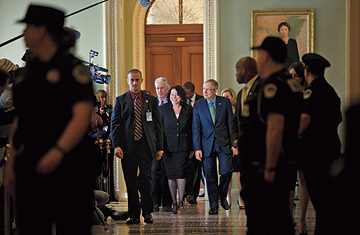
Sotomayor hits the Capitol with Senator Harry Reid, right.
(5 of 5)
Sotomayor's more liberal inclinations in immigration cases may also make a difference on a court that will increasingly have to wrestle with legal distinctions in the U.S. between citizens and aliens. As Obama disappoints civil libertarians by reaffirming aspects of President Bush's antiterrorism policies--including the claim that terrorism detainees held by U.S. forces in Afghanistan have no legal right to challenge their detention in U.S. courts--some of these policies may reach the Supreme Court. Sotomayor could prove skeptical of the claim often made by the government that the rights of aliens differ sharply from the rights of citizens in the war on terrorism and in other cases.
If Sotomayor is confirmed, as expected, the only thing one can confidently predict is that the cases involving race and diversity that she will confront are very different from the ones we are thinking about today. In that sense, the evolution of Sotomayor's thinking in the years ahead may be more consequential than what she has said in her past.
Rosen, a law professor at George Washington University, is the author of The Supreme Court: The Personalities and Rivalries That Defined America
Hard Cases. How Sotomayor ruled on some key race-based disputes
[This article contains a table. Please see hardcopy of magazine or PDF.]
RICCI V. DESTEFANO HAYDEN V. PATAKI GANT V. WALLINGFORD BOARD OF EDUCATION The facts in the case The New Haven, Conn., fire department dismissed the results of a promotion test because none of the top scorers were black. White firefighters sued the city, claiming they had been discriminated against by its decision not to promote on the basis of test results. A majority of the appeals court rejected the claim that a New York State law denying the vote to currently incarcerated felons, in combination with historical discrimination in the criminal-justice system, constituted a violation of the federal Voting Rights Act. A majority of the court dismissed a suit filed on behalf of a black 6-year-old whose family claimed that school officials had discriminated against him by demoting him from first grade to kindergarten. How Sotomayor decided In an unsigned opinion, the three-member appellate panel rejected the firefighters' anti-discrimination suit. The panel held that the city's refusal to certify test results that had a disproportionate racial impact was protected under the law. The case is before the Supreme Court. Sotomayor dissented, arguing that the text of the Voting Rights Act applies to all "voting qualifications." She added, "The duty of a judge is to follow the law, not to question its plain terms ... I do not believe that Congress wishes ... to invent exceptions to these statutes." Sotomayor filed a partial dissent, arguing that a "jury reasonably could conclude that the school did not give the black student an equal chance to succeed (or fail)." She added that the student was "entitled to an equal opportunity to learn, and failing that a full hearing in court."