

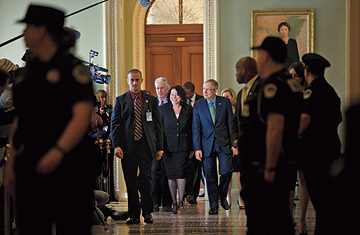
Sotomayor hits the Capitol with Senator Harry Reid, right.
Of the thousands of cases Sonia Sotomayor has heard during nearly 17 years on the federal bench, the one likely to raise the toughest questions during her Supreme Court confirmation hearings, which begin on July 13, involves affirmative action. In 2007 Sotomayor, as a member of the Second Circuit Court of Appeals, heard arguments in the case of Ricci v. DeStefano. In that case, white firefighters in New Haven, Conn., challenged the city's decision to ignore the results of a promotion test after there were no black firefighters among the top scorers. One of 20 white firefighters who brought the case, Frank Ricci, is dyslexic and paid an acquaintance more than $1,000 to read study guides for the test onto audiotapes. Ricci scored sixth out of 77--high enough to merit the promotion. But the city, fearing that it could be sued for discrimination, decided to promote no one.
During the oral argument for the case, Sotomayor was an active questioner, but the decision eventually released by her three-judge panel was a brief, unsigned order. With little explanation, it affirmed the lower-court decision dismissing the firefighters' claim that the city discriminated against the white firefighters by throwing out the test. In a subsequent opinion, one of Sotomayor's colleagues and longtime mentors, Judge José Cabranes, criticized the panel for disposing in such a cursory way issues that were "indisputably complex and far from well-settled." Ricci and the others appealed the panel's ruling, and the case is now before the Supreme Court.
Republican critics of Sotomayor are planning to use the Ricci decision as Exhibit A in what they hope will be confirmation hearings focused on her views about race. Exhibit B is a speech she delivered in 2001 that included the following 32 words: "I would hope that a wise Latina woman with the richness of her experiences would more often than not reach a better conclusion than a white male who hasn't lived that life." Since President Barack Obama nominated Sotomayor to the court on May 26, that remark has become the main source of conservative attacks. Former Speaker of the House Newt Gingrich told his followers on Twitter that Sotomayor was a "Latina woman racist" who should withdraw. (He later apologized.) Sotomayor expressed regret about her word choice to Senator Dianne Feinstein. But after the Senate Judiciary Committee released Sotomayor's complete list of speeches, it emerged that she had delivered many versions of the same stump speech--seven by one count--between 1994 and 2003. In all of them, she suggested that a judge who was a "wise woman" or a "wise Latina woman" would issue a better opinion than a male or a white male judge.
Sotomayor's defenders say that those words were taken out of context and that her appellate opinions are hardly radical on race. Tom Goldstein of SCOTUS Blog has estimated that of the 96 race-related cases other than Ricci she heard on the Court of Appeals, "Judge Sotomayor rejected discrimination-related claims by a [ratio] of roughly 8 to 1."