

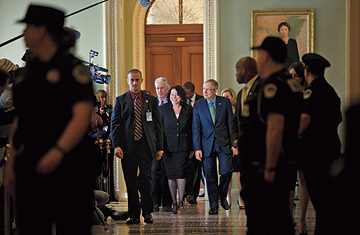
Sotomayor hits the Capitol with Senator Harry Reid, right.
(4 of 5)
On civil rights cases--including race, gender and immigration appeals--Sotomayor tilts more to the left; Lindquist characterized her majority opinions as 54% liberal and 46% conservative. But when you break out the seven majority opinions involving race, only three rule in favor of the discrimination plaintiffs. It's in the immigration and gender cases that Sotomayor shows clearer signs of liberal leanings: out of 28 majority opinions in immigration cases, Sotomayor decided in favor of the immigrant in 17, or 61%. And in four gender cases, involving sex discrimination and sexual harassment, she decided in favor of the plaintiff all four times.
But it's in dissents rather than in majority opinions that appellate judges often reveal their true feelings. Of Sotomayor's 19 published dissents, only three dealt clearly with racial issues, and they pointed in different directions. In a 1999 case, Gant v. Wallingford Board of Education, Sotomayor would have allowed a 6-year-old African-American student to challenge as racial discrimination his school's decision to demote him from first grade to kindergarten. In Pappas v. Giuliani (2002), Sotomayor would have held that the New York City police department may have violated the First Amendment when it fired a police officer for his racist, anonymous speech. And in Hayden v. Pataki (2006), Sotomayor said that a New York State law barring felons from voting violated the federal Voting Rights Act. Sotomayor does not appear to be an outlier in race cases, although she seems to have no overarching theory about how to decide them. For that reason, she seems unlikely, in the short term, to affect the balance on the Roberts Court in cases involving race. At the moment, the court is divided among four color-blind conservatives who are suspicious of affirmative action, four liberals who are sympathetic to it, and Anthony Kennedy, who is skeptical of racial classifications but reluctant to strike all of them down, in the middle. On most cases, Sotomayor can be expected to assume David Souter's current spot as the fourth member of the liberal bloc.
Future Fault Lines
But Sotomayor's unique background and views about race and gender are likely to become more important over time. In coming years, there may well be challenges to the death penalty, for example, on the grounds that it is imposed in a racially discriminatory way. The court rejected that claim in 1987, but Sotomayor might be sympathetic to it. In 1981, as a member of the board of directors of the Puerto Rican Legal Defense and Education Fund, she was part of a committee that recommended that the fund oppose the reinstatement of the death penalty in New York State on the grounds that "capital punishment is associated with evident racism in our society."