

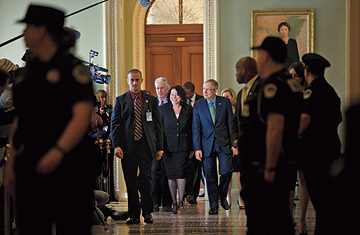
Sotomayor hits the Capitol with Senator Harry Reid, right.
(2 of 5)
So, what does she actually believe? An examination of Sotomayor's career supports the idea that on the bench, she has been a racial moderate, not a radical. At the same time, her opinions and speeches suggest that her views about race, multiculturalism and identity politics are more nuanced, complex and provocative than either her critics or her supporters have allowed. And for that reason, if confirmed, she could influence the racially charged issues the Supreme Court will confront over the next few decades in unexpected ways.
The Richness of Experience
The first speech in which Sotomayor introduced the "wise Latina" theme was delivered in Puerto Rico in 1994 and focused not on race but on gender. Sotomayor was responding to an article written by a colleague, Miriam Goldman Cedarbaum, a federal judge in New York. Cedarbaum, like Justice Sandra Day O'Connor and Justice Ruth Bader Ginsburg, was an "equal treatment" feminist, who had expressed concern about the premise that women judges necessarily approach cases differently than men do. "Generalizations about the way women or men are," Ginsburg famously said, "cannot guide me reliably in making decisions about particular individuals."
Sotomayor, in her speech, takes a very different view from Ginsburg's and O'Connor's. She sympathizes with "difference feminists" and then says she is not sure she agrees with O'Connor's reputed statement that "a wise old man and a wise old woman reach the same conclusion in deciding cases." Sotomayor concludes, "I would hope that a wise woman with the richness of her experience, would, more often than not, reach a better conclusion"--and then defines "better" as a "more compassionate, and caring conclusion." She also recommends a 1993 article in Judicature, a legal journal, that found that women judges reached different conclusions from men in employment-discrimination cases but not in obscenity or criminal cases. The claim that gender makes a difference in some categories of cases is widely accepted today, but academic theorizing about women's essential differences still remains hotly debated.