

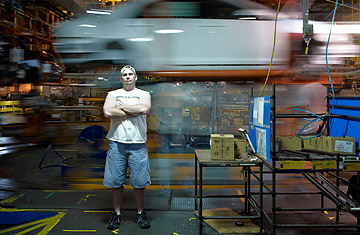
Autoworkers at GM's Fairfax plant in Kansas City, Kans., are part of a new lower-cost labor deal.
(5 of 6)
The UAW, meanwhile, has been asked to take a deal similar to the one struck with Chrysler. Autoworkers would give up some holidays and bonuses. Their wages would not automatically rise in the future as they had in the past. Some 20,000 jobs would be cut, and future hires would earn wages comparable to those paid in Toyota's U.S. factories. When those givebacks are added to an earlier surrender of the notorious "jobs bank"--which paid laid-off autoworkers for doing nothing--clearly the UAW's once heavenly bed has lost much of its fluff. What remains is the VEBA, the multibillion-dollar trust fund designed to protect a key element of the membership's fabled retirement benefits--which the union refers to as deferred wages. As in the Chrysler deal, the UAW agreed to trade a chunk of the cash GM owed the VEBA for 17.5% equity in the company and other considerations.
This piece of the transaction has proved most controversial--and is perhaps the biggest potential obstacle to a smooth reorganization of GM. The problem: the VEBA's haircut--trading promised cash for riskier shares--is less severe than the deal offered to some bondholders. And that's not the way bankruptcy is normally done.
Bankruptcy law ranks claims against a failed company. Stockholders have the weakest claim--they made a bet on success, got failure instead, so too bad. The strongest claims belong to secured lenders, which are first in line for any proceeds if the company is liquidated. In between lie the unsecured claims. For a carmaker, this creditor class includes suppliers who haven't been paid, car owners whose repairs ought to be covered by warranty, dealers seeking reimbursement for manufacturers' rebates--and the UAW seeking a VEBA payment.
Some lenders have been galled to see the Democratic Administration, whose party receives millions from the UAW each election cycle, giving a sweeter deal to the union than was offered them. Task-force members counter that other unsecured claims have received even better deals than the union's. Warranties, for example, have been 100% guaranteed--no haircut at all. "We're trying to avoid liquidation, and so these claims have to be classified according to their importance to the future viability of the company," a task-force official explained. "Obviously you can't sell cars without warranties. You can't make cars without suppliers. So most of those claims are being paid. And you can't build cars without skilled workers."
A few Chrysler bondholders tried to resist but were overwhelmed by the megabanks that held most of the secured debt. Having taken billions in bank bailout money, they were in no position to irritate the Treasury Department. GM's debt is more widely dispersed, however, which makes it harder to muscle a settlement. To avoid a morass in court, the task force agreed at the 11th hour to fully repay GM's secured lenders, using stock in the reorganized company.
A Death in the Family
So the bottom line: the government's auto rescue is perhaps misshapen, certainly improvised, highly controversial and hugely expensive--up to $70 billion and counting for GM alone. In Chrysler's case, success is a long shot. As for GM, the restructured company will find itself struggling to balance the many demands our society places on the auto industry.