

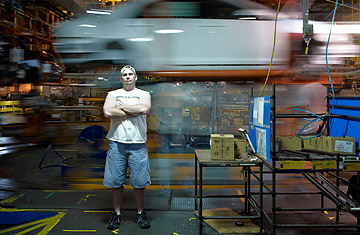
Autoworkers at GM's Fairfax plant in Kansas City, Kans., are part of a new lower-cost labor deal.
(3 of 6)
But that's not possible at a time when Obama and congressional leaders are requiring Detroit to do more to advance conservation and alternative energy and create 5 million green jobs. "I am absolutely committed to working with Congress and the auto companies to meet one goal: the United States of America will lead the world in building the next generation of clean cars," Obama said in March. Other public buttons have been pressed as well. Senators Robert Byrd and Jay Rockefeller of West Virginia called on Treasury to go easy on small-town car dealers, who create jobs and pay taxes in far-flung communities. Pension and health-insurance benefits that might have been wiped out in a strictly commercial bankruptcy have instead been elevated to priorities.
On March 26, Obama convened the task force in the Roosevelt Room. By then, as Rattner explained to the President, a commercially sound plan for a stand-alone Chrysler was out of the question; it was deeply in debt, bleeding money and saddled with unpopular products. Of the 20 best-selling vehicles in the U.S. in 2008, only one, the Dodge Ram pickup, was made by Chrysler--compared with five for GM and four for Ford. A venerable European carmaker, Daimler, had already tried and failed to revive Chrysler. Its current owner, the private-equity fund Cerberus, had spent months of fruitless globetrotting in search of another car company willing to give it a try.
Make that nearly fruitless. Marchionne, CEO of Italy's Fiat, had sniffed an opportunity lurking by the Chrysler deathbed. Chased from the American market a generation ago by its comic reputation for poor quality, Fiat seemed an unlikely rescuer. But Marchionne entered the picture as the It boy of the auto world, having slashed costs, retooled management and refreshed styling to boost sales of the firm's cute little cars. He wanted back into the U.S., provided it didn't cost him anything.
His lowball--bid seems the wrong word--offer went like this: If the U.S. government would wipe out Chrysler's shareholders, buy out its bondholders, cut wages and jobs, deal with its retirement liabilities and fund the warranties, then Fiat would take a crack at Chrysler. The Italians would bring their cars to Chrysler's showrooms and share their advanced diesel technology with Chrysler engineers. Chrysler might sell some cars in Fiat's markets--Jeeps may have the best overseas appeal. Marchionne would lend his managerial chops. And if things worked out, Fiat would take a controlling share.
Rattner, an icy-eyed, sharp-spoken Wall Street dealmaker, laid out Obama's unappealing options. Chrysler could be scrapped for parts through an unstructured bankruptcy. Or the task force could try to make the Fiat proposal work, using the leverage of bankruptcy to force concessions and the Treasury's wallet to refinance the debt and recapitalize operations as debtor in possession. Some task-force members argued that, painful as it would be, liquidating Chrysler would strengthen the survivors--GM and Ford.