

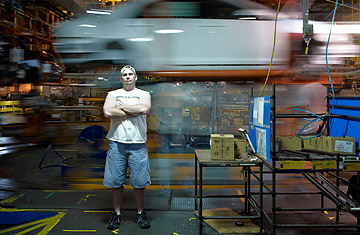
Autoworkers at GM's Fairfax plant in Kansas City, Kans., are part of a new lower-cost labor deal.
Nearly 80 years ago, around the time a Kansas-born carmaker was putting his name on the newest, tallest, shiniest building in the world, a young auto mechanic named Morris Weinberg opened a repair shop on busy Brooklyn Avenue in Kansas City, Mo. As he modestly prospered, fixing and selling used cars, Weinberg dreamed that his son would enter the auto business. Not used cars, though--new cars. Sleek and powerful cars, like the ones built by Walter Chrysler's company. And that's how Steve Weinberg, with his father's savings to stake him, came to open a Dodge dealership in Grandview, Mo., in 1966.
On May 14, 2009, a panel truck pulled up to Weinberg Dodge bearing a letter from Chrysler, informing Morris Weinberg's son that his career in the new-car business would be over in about three weeks. There wasn't much in the way of explanation, but it comes down to this: Chrysler's sales can't support a dealer network built for another era.
Neither can General Motors'. The company is in the process of axing 1,100 of its 6,000 dealers. When the march of time, the sins of management and the scythe of a bad economy conspire to bankrupt once great companies, who pays? The sort of person, in the words of Tennessee Senator Bob Corker, "who ran a profitable business, civic leader, always responsible," who "very unfortunately" is "going to take a lot of pain" for the mistakes of others. A guy like Steve Weinberg. "It breaks your heart," says the Senator.
Better to break hearts locally than shatter the greater economy--and that's what the collapse of GM and Chrysler threatens to do, according to the White House auto task force that is undertaking the monumental rescue mission. In the deal being cobbled, GM's stockholders will be wiped out, replaced as equity owners by the Treasury Department, with 70%, and the United Auto Workers (UAW), with 17.5%. GM's business in Europe, Opel, will be sold. As many as 14 U.S. factories are marked to close. The iconic Pontiac brand is probably finished. Under a new labor agreement with the UAW, GM's hourly domestic workforce, which numbered 600,000 at its peak, will drop to 40,000. In other words, 14 of every 15 GM jobs have vanished in roughly a generation. And the ripples: dealers losing franchises, thousands of suppliers doomed.
And that's if things go according to plan. Holders of $27 billion in GM bonds have refused the company's debt-for-equity swap, making bankruptcy all but inevitable. For purist capitalists, the lasting significance of GM's pending Chapter 11 (and Chrysler's bankruptcy, filed a month ago) is the overwhelming intrusion into the private sector by Barack Obama and his auto task force at Treasury. "The day they fired the CEO of General Motors"--Rick Wagoner was dismissed by task-force co-chairman Steve Rattner in late March--"is a day we will look back on with great regret," predicts Corker, a reluctant and critical supporter of the bailout. "The government has no business making those kinds of decisions." Critics of the government's involvement maintain that bondholders have been punished, union workers coddled and laws flouted in the process. And they worry that should GM emerge from Chapter 11 with the U.S. Treasury as majority shareholder--Government Motors--we will have crossed a frontier separating capitalism from socialism, even though the company will be run by existing management.