

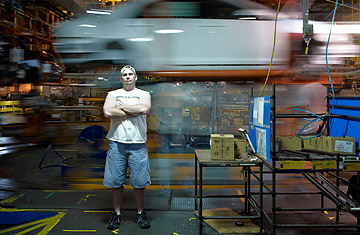
Autoworkers at GM's Fairfax plant in Kansas City, Kans., are part of a new lower-cost labor deal.
(4 of 6)
Bloom argued Fiat's case, Chrysler's case and ultimately the UAW's case. Gangly and soft-spoken, Rattner's co-chairman is passionately pro-union--an unusual trait among investment bankers. He helped guide the steelworkers' union through the collapse and restructuring of its industry, and this time he came to the aid of Chrysler's workforce. Gene Sperling, a veteran of the Clinton Administration, added his weight to Bloom's, speaking movingly of the human devastation that would follow should Chrysler collapse at such a weak moment for the overall economy.
Obama asked Rattner to rate the chance that a Fiat deal could be struck, given all the competing interests and Chrysler's extremity. "Fifty-one percent," Rattner answered. "And in my experience, deals get worse, they don't get better" as they take concrete form. On that note, Obama decided to press ahead, sparing Chrysler from the merciless marketplace.
Over the next month, the task force rammed through an odd-looking arrangement: The government would put up the money. The UAW's Voluntary Employee Beneficiary Association (VEBA)--a trust set up at Chrysler and other U.S. carmakers to shift retiree health-care obligations off company books--would own a majority of the shares. Fiat would run the place. And some sort of entity called Chrysler would survive. Despite the protests of some bondholders, the deal was sent to receive the blessing of a bankruptcy judge.
Was it commercial? Experts scratched their heads. "We're all kind of struggling with it," says automotive consultant Laurie Harbour-Felax. To Corker, the deal was an exercise in pain management. "I get the sense that they decided to kick the can down the road, maybe delay the end for another four or five years," he says. "And then if it fails, at least a foreign company owns it."
The Politics of Haircuts
GM followed Chrysler toward bankruptcy like the next car on a roller coaster. The path was clear: if Chapter 11 was necessary to restructure the smaller, privately owned company, it would surely be needed to resolve the troubles of the publicly held behemoth. But simply seeing where things were headed didn't change the fact that it would be a wild ride.
The failure of GM was a long time in coming, but in a sense, its case was more promising than Chrysler's. Given the strides GM has been making to repair decades of mismanagement--streamlining production, coordinating design, improving quality--there was a chance the company might have saved itself in a better economy. But with American vehicle sales dropping from 16 million in 2007 to a projected 9 million or 10 million this year, GM had no hope of servicing its massive debt.
The company put Saab, Opel, Saturn and Hummer up for sale, then killed Pontiac. (Marchionne promptly entered fire-sale bids for Opel and Saab.) As the expected bankruptcy filing approached, plans were under way for a complicated stock deal that would render existing shares essentially worthless. Secured bondholders were being offered full payment in new company stock, while others were being told to expect far less.