

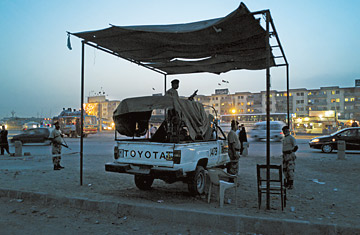
Paramilitary rangers keep watch on apartments in Karachi suspected of harboring Taliban militants. In the past 18 months, hundreds of terrorist attacks have taken place in Pakistan.
(4 of 5)
Yet continue it does. Every day, it seems, another police official or politician proclaims that he has definitive proof that a "foreign hand" (read: India) is behind the latest bombing. The proof is never produced. It is enough that it bolsters the delusion that Pakistanis are not responsible for the crisis in their own country and thus are exempted from dealing with it.
Resenting the U.S.
Of late, the U.S. administration has sought to convince Pakistani leadership that the Indian threat on the eastern border has passed and that troops should be moved to the west, where both Pakistani and Afghan Taliban have set up training camps. To many Pakistanis, that message is suspect. The Americans have too long a history of pursuing their own interests in the region, they say. The rapid U.S. withdrawal at the end of the Soviet war in Afghanistan left Pakistan in chaos. America's long support for former President Pervez Musharraf's military rule alienated Pakistanis even further. Now it is commonly accepted that every political move in the country conceals an American motive, a belief shared by many Pakistanis living abroad. "It's well known that the present civilian government headed by a corrupt psychopath was conjured up by the U.S. and U.K. to push their agenda," says Dr. Riaz Ahmed, a pediatrician practicing in the U.K. "Pakistan has been helping the Americans with their war, and what do they get in return? Violence, drugs, instability. We Pakistanis think we are being bullied into somebody else's war."
That resentment is fueled by a belief that Pakistan is suffering for Washington's failures. Zardari may say that the war on terrorism is as much Pakistan's as it is the U.S.'s, but that message has yet to take root. The growing militancy in Pakistan's tribal areas "is the price we are paying now for supporting the American war on terror," says Ahsan Iqbal, information secretary for the opposition party Pakistan Muslim League (Nawaz). "If we stopped supporting the American war [in Afghanistan], we would have peace tomorrow." Iqbal dismisses recent accounts in the Western press of growing Talibanization in the country as "propaganda." Shireen Mazari, a right-wing columnist, sees even more sinister plots afoot. "Is it really in the American interest to have a stable Pakistan right now?" she asks. "Or is it actually pushing us towards instability in order to achieve its agenda of obtaining access and control over our nuclear assets?" Says Rashid: "All of us go by conspiracy theories. We are all blaming somebody else for our mistakes. Why don't we wake up and start blaming ourselves?"
Missed Opportunities
One answer to that question is, because Pakistan's leaders have been so feckless. When Benazir Bhutto was assassinated in December 2007, her husband Zardari assumed leadership of her political party and then the presidency. Zardari swore to bring his wife's killers to justice. He has not done so, instead wasting an opportunity to rally the nation against terrorism. There is no national media campaign to combat Taliban propaganda and no clerics on TV or radio denouncing suicide bombers.