

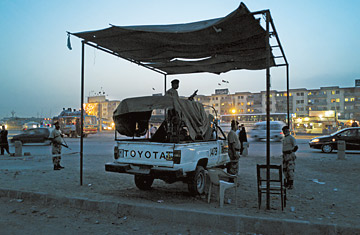
Paramilitary rangers keep watch on apartments in Karachi suspected of harboring Taliban militants. In the past 18 months, hundreds of terrorist attacks have taken place in Pakistan.
In the Himalayan resort town of Nathiagali, a party is under way. Ice clinks in tumblers and corks pop while the conversation--an amalgam of English and Urdu that is the mark of Pakistan's élite--flows from meditation techniques to a heated debate over a U.S. politician's warning that Pakistan is on the brink of collapse. The hostess, Rifat Haye, 54, is one of two female pilots with the national airline and is celebrating her promotion to captain. She wears jeans. Her hair is streaked with blond, and a diamond nose stud glints in the sun, as does the jeweled Allah pendant around her neck. She is frustrated with the image the world has of Pakistan, that of a failing state overrun by Muslim fanatics. Pointing first to herself, then at her guests, she says, "This is Pakistan." Then she waves her hand over the valley beyond the deck of her summer cabin. "But that is also Pakistan."
By that she means all those Pakistanis who do not belong to her class and who have as much to do with the Taliban as she does, which is to say nothing at all. But her sweeping wave inadvertently encompasses a part of Pakistan she has failed to address--the Swat valley, where the army has embarked on a campaign to rout out Islamic insurgents who threaten to destroy the Pakistan Haye knows and cherishes.
Pakistan is a complicated country, one of religious and political diversity, fractured by class and ethnicity. Pakistanis like to quip that they have a population of 170 million--and as many different opinions. Which is why defensiveness sets in when outsiders attempt to reduce the country to a terrorist statistic. The problems in Swat don't define Pakistan, says Haye. It's not that she doesn't care--she does--but that Pakistan has very little to do with her Pakistan. "What is all this talk of Talibanization? Not once have these maulvis [religious leaders] complained that a woman is flying their plane," she says. Guests nod in agreement. "There is no way the Taliban can take over Pakistan," says one. "We are too many, and they are too few."
It is indeed unlikely that Pakistan's Islamic militants can seize power. But to spread fear and insecurity and slow down economic development, they don't need to. Hundreds of terrorist attacks have taken more than 2,500 lives in the past 18 months. Talibanization may not have reached Pakistan's élite, but it is already threatening others. Women in the city of Rawalpindi complain that they are harassed if they don't wear headscarves. In Lahore, a prep school for girls has banned the wearing of blue jeans, for fear of a Taliban attack. In the capital, Islamabad, the Red Mosque's prayer leader, Abdul Aziz, sanctioned vigilante squads of baton-wielding women to go out and threaten video stores, barbershops and massage parlors for being un-Islamic. Two years ago, his followers kidnapped six Chinese masseuses, calling them prostitutes, and held them hostage. The army eventually cracked down, launching a siege and battle that saw the death of nearly 100 militants. Last month, Aziz was released from prison on the condition that he would not preach against the state. But residents in the neighborhood fear that the vigilante squads will soon be back. Talibanization doesn't start with a military takeover. It happens when there is a Red Mosque in every city and citizens are afraid to stand up to its edicts.