

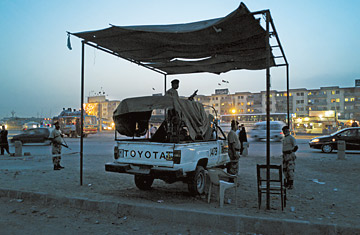
Paramilitary rangers keep watch on apartments in Karachi suspected of harboring Taliban militants. In the past 18 months, hundreds of terrorist attacks have taken place in Pakistan.
(2 of 5)
The government, at last, seems to be fighting back. On May 7, Prime Minister Yousuf Raza Gilani announced a military operation in Swat. "The armed forces have been called in," he said, "to eliminate the militants and terrorists. We will not bow before extremists." Only weeks before, the government had finalized a peace deal with the militants in which their principal demand--the establishment of Islamic law in the area--was granted in exchange for giving up arms. At first officials defended the deal, even as the militants moved on a neighboring district and their leader announced that democracy was contrary to Islam. But in a move that coincided with Pakistani President Asif Ali Zardari's visit to Washington, the government declared the deal over. "The militants have waged war against all segments of society," Gilani said. "I regret to say that our bona fide intention to prefer reconciliation with them was perceived as a weakness on our part."
The fighting in Swat masks far more serious problems. In Waziristan, a region on the Afghan border, security forces have ceded control to the militants. Outlawed sectarian groups are gaining a foothold in Punjab province. And in the financial capital of Karachi, where Pakistani Taliban insurgents raise funds, ethnic clashes claimed more than 30 lives last month. When U.S. President Barack Obama commented during an April news conference that the Pakistani government did not "seem to have the capacity to deliver basic services--schools, health care, rule of law, a judicial system that works for the majority of the people," the nation erupted in fury, and effigies of Obama were burned. But privately many Pakistanis agreed with the U.S. President; their nation, for all its people's many talents, has failed to develop the education, economic-development and justice systems that are the bedrock of modernity and stability. "These guys have been in power for more than a year," says lawyer Anees Jillani, speaking of Zardari's government. "What have they done? We still have acute poverty, joblessness and injustice."
A Crisis of Identity
To criticize Pakistan's leaders, however--much though they may deserve it--is to miss the point. It is ordinary people, locked in a series of personal Pakistans, who seem unable or unwilling to unite over the threat to their nation. Pakistanis will point to the oppressive hand of history or the machinations of foreign nations to explain their descent into chaos, and to a certain extent both have played a role. But no one bears more responsibility for a slow collective suicide than Pakistanis themselves. A set of failures has contributed to Pakistan's fall.
Founded as a Muslim nation carved from British-ruled India in 1947, Pakistan has long struggled to unite a population divided by language, culture and ethnicity. It is quite true that Pakistan may never have resolved what Sabahat Ashraf, a Pakistani blogger now living in California, calls its "existential dilemma: Are we an Islamic state, or are we a state of Muslims?" but Islam has always been a common denominator. When the Soviet Union invaded Afghanistan, the nation rallied under the banner of jihad. Today any attack on Islam, even the perception of one, is akin to an assault on Pakistan's very identity. When the militants say they too are fighting for Islam, just as the mujahedin fought the Soviets, it creates a sense of paralysis.