

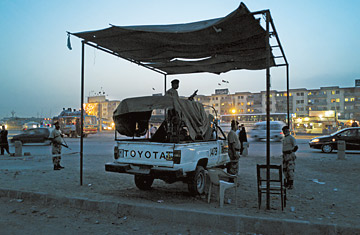
Paramilitary rangers keep watch on apartments in Karachi suspected of harboring Taliban militants. In the past 18 months, hundreds of terrorist attacks have taken place in Pakistan.
(3 of 5)
Pervez Hoodbhoy, a professor at Islamabad's Quaid-i-Azam University, pulls up on his laptop the pages of a first-grade primer distributed in private religious schools. "A is for Allah," he reads. "B is for bandook, or gun." T, for thakrau, collision, is illustrated with a drawing of the World Trade Center in flames, while Z, for zenoub, the plural of sin, is depicted with alcohol bottles, kites, guitars, drums, a television and a chess set. Any attempt to change the religious curriculum is met with fierce resistance. "Many fear that to be seen protesting against the extremists who are pushing Shari'a [Islamic law] would be seen as protesting against Islam itself," says Hoodbhoy.
The paradox here is that historically, Pakistanis have practiced a syncretic version of Islam that venerates saints and emphasizes a personal relationship with God. But the influx of Arab preachers during the war against the Soviets brought a more austere form of the religion. Shayan Afzal Khan, an Islamic scholar who writes about women and Islam, thinks Pakistanis lack the confidence to defend their moderate beliefs. "People are afraid to take on the mullahs because we can't quote the Koran the way they do," Khan says. "We have to take our religion back," but fear gets in the way. She has decided not to publish her most recent book, about early Muslim women, in Pakistan "because the situation these days is too unstable."
Blaming India
If Pakistanis have defined themselves by their religion, they have also defined themselves by what they are not--Indian. The bloody cleavage that marked the birth of two independent nations began a long enmity cemented by three wars and the threat of mutual nuclear annihilation. The contested territory of Muslim-majority Kashmir is the flame that keeps the pot boiling. In Pakistan every prayer ends with a thought for Kashmir. Pakistanis find it impossible to believe that India, with its booming economy and flourishing democracy, has moved on from the rivalry; India, many believe, still seeks the destruction of its neighbor.
One afternoon in early May, an upscale audience gathered in Karachi to hear veteran journalist Ahmed Rashid speak on the Taliban threat. For years, Rashid has been Pakistan's Cassandra, prophesying an extremist-led doom to deaf ears. Now that the threat has become reality, he is a sought-after speaker. "I no longer say that there's a creeping Talibanization in Pakistan," he warned. "It's a galloping Talibanization." For 45 minutes, he expanded on his theme, explaining how the Pakistan Army's narrow focus on India has allowed the militant threat within the country to fester, how money that should have been spent on helicopters to combat the insurgency was squandered on fighter jets better suited to attacking India. But the message failed to sink in.
After his speech, Rashid was peppered with questions about India's designs to destabilize the country, until he exploded with frustration: "We are still getting told every night on our TVs that these Pakistani Taliban are all getting their money from India, that they are armed by India. Until we recognize the fact that this is a homegrown phenomenon and that the people throwing acid into girls' faces are Pakistani, the problem will continue."