

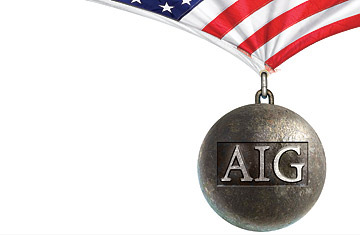
AIG photo-illustration
(5 of 7)
Keeping the financial system fluid might explain why so many banks got paid in full, which strikes some as a scandal way bigger than the bonus payouts. Many experts wondered why AIG paid 100 cents on the dollar. Among the biggest beneficiaries of the AIG pass-through, at $12.9 billion, was Goldman Sachs, the investment-banking house that has been the single largest supplier of financial talent to the government. Critics have been quick to note--and not favorably--the almost uncanny influence of former Goldman executives. Initial phases of the rescue were orchestrated by ex--Goldman chairman Hank Paulson, who was recruited as Treasury Secretary in part by former White House chief of staff and Goldman senior exec Josh Bolten. Goldman's current boss, Lloyd Blankfein, was invited to participate in meetings with the Fed. AIG's Liddy is a former Goldman director and an ex-CEO of Allstate. Another alum, Mark Patterson, once a Goldman lobbyist, serves as chief of staff at the Treasury, while Neel Kashkari, who runs TARP, was a Goldman vice president.
Goldman has repeatedly declared that its exposure to AIG was "immaterial" and fully hedged. But some rivals point to the fact that Goldman had uncharacteristically piled into contracts with a single counterparty. "I am shocked that Goldman had this much exposure [with AIG]," says an analyst at a competing bank. "This was a major failing, but they got bailed."
Goldman got bailed twice: first on its CDS exposure and a second time, to the tune of $4.8 billion, for another AIG fiasco, losses on its securities-lending business.
Securities-lending is supposed to be a sort of Christmas club of high finance. Companies like insurers, which own tons of equities and Treasury bonds that they are holding long term, lend them out short term, often overnight, to borrowers who need the shares to fulfill other commitments. For instance, if hedge funds want to sell shares short, they borrow them, putting up cash collateral that includes a small spread to the lender. Typically, the owner of the shares takes that collateral and invests it in something with low risk and of short duration, like commercial paper. The lender is exposed to some risk, but it usually isn't catastrophic. However, AIG took the collateral and invested in longer-term, higher-risk mortgage- and asset-backed securities. "Crap," as a portfolio lending expert describes them. When those securities crashed in value, so did AIG.
Between the CDS and securities-lending fiascoes, AIG still has lots of work to do. Gerry Pasciucco, the new head of AIG FP, is working to whittle down AIG's trading book by $1.1 trillion. Which raises the question, Does he really need those $165 million bonus babies to finish the job? AIG says yes, because they know the trades and the system, but not everyone agrees. "This is an engineering problem," says Rick Bookstaber, a risk expert and the author of A Demon of Our Own Design, which predicted the predicament we're in. "Right now there are probably a million guys out there who can do it."
The Great Clawback