

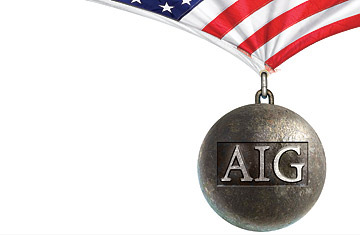
AIG photo-illustration
(2 of 7)
Those questions have taken on greater urgency, since it turns out that AIG has become the banking industry's ATM, essentially passing along $52 billion of TARP money to an array of U.S. and foreign financial institutions--from Goldman Sachs to Switzerland's UBS. Those firms were counterparties to the credit-default swaps (CDSs) that AIG FP sold at least through 2005, and the companies were collecting on the insurance-like derivatives. AIG paid out an additional $43.7 billion to many of the same banks, which were also customers of the securities-lending operation run out of AIG's insurance division. In this case, AIG managed to take a business specifically designed to be low risk, low return and amp it into another dicey venture--with taxpayers on the hook.
The outrage will pass, and when it does, we're going to have to focus on whether keeping AIG afloat is preventing a sharp recession from becoming a prolonged one. The reason AIG has cost taxpayers $170 billion--and the reason the Obama Administration seemed willing, at least at first, to hold its nose and accede to bonuses for the company's managers--is that it's too big to fail. It's an often heard phrase, but what does it really mean?
The idea is that in a global economy so tightly linked that problems in the U.S. real estate market can help bring down Icelandic banks and Asian manufacturers, AIG sits at some of the critical switch points. Its failure, so the fear goes, would set off chains of others, rattling around the globe in short order. Although some critics say the fear is overblown and the world economy could absorb the blow, no one seems particularly keen on testing that approach.
How We Got Here
AIG seems an unlikely candidate for the company that could bankrupt the planet. Founded 90 years ago in Shanghai, AIG moved its headquarters to New York City as the world headed toward war in 1939. After Maurice R. (Hank) Greenberg took over in 1967, AIG consolidated its global empire. By the time Greenberg was forced out in an accounting scandal 38 years later, AIG had become one of the world's biggest public companies, with sales of $113 billion in 2006 and 116,000 employees in 130 countries, from France to China.
AIG says it has written more than 81 million life-insurance policies, with a face value of $1.9 trillion. It covers roughly 180,000 small businesses and other corporate entities, which employ approximately 106 million people. That makes AIG America's largest life and health insurer; second largest in property and casualty. Through its aircraft-leasing subsidiary, AIG owns more than 950 airline jets. Just for good measure, AIG is a huge provider of insurance to U.S. municipalities, pension funds and other public and private bodies through guaranteed investment contracts and other products that protect participants in 401(k) plans. "We have no choice but to stabilize [it] or else risk enormous impact, not just in the financial system but on the whole U.S. economy," said Fed Chairman Ben Bernanke.