

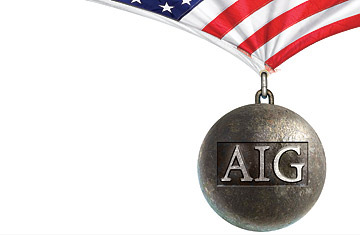
AIG photo-illustration
(3 of 7)
The risk is not in any one business but in the connections among them and in the industries in which they compete. As AIG has pointed out in its own analysis, "The extent and interconnectedness of AIG's business is far-reaching and encompasses customers across the globe ranging from governmental agencies, corporations and consumers to counterparties. A failure of AIG could create a chain reaction of enormous proportion." Among other effects, it could lead to mass redemptions of insurance policies, which would theoretically destabilize the industry; the withdrawal of $12 billion to $15 billion in U.S. consumer lending in a credit-short universe; and even damage airframe maker Boeing and jet-engine maker GE, since AIG's aircraft-leasing unit buys more jets than anyone else.
While AIG's holdings are diverse, nearly all its losses centered on AIG FP, which until March 2008 was led by its high-rolling president, Joseph Cassano, a tough-talking Brooklyn, N.Y., native who in the past eight years banked $280 million in cash compensation, or exactly $115 million more than the bonuses at the center of the current controversy. Cassano, who helped found the AIG FP unit in 1987, built his money machine not on anything fraudulent but on what's been described as regulatory arbitrage. As Bernanke explained recently, "AIG exploited a huge gap in the regulatory system. There was no oversight of the Financial Products division. This was a hedge fund, basically, that was attached to a large and stable insurance company."
That hedge-fund-like unit built up a portfolio of $2.7 trillion in derivatives. AIG FP eagerly offered to insure billions of dollars in derivative portfolios, building up potential liabilities many times its capacity to pay out if the portfolios defaulted. Few financial experts ever imagined the scope of the impending defaults. Neither did regulators. AIG's uncollateralized insurance combine was regulated by Washington's Office of Thrift Supervision, whose task is to watch over savings-and-loan companies, not global insurers. And it wasn't watching.
AIG, like other institutions, was making a mint dealing in derivatives tied to the U.S. real estate market. The boom was financed in part by collateralized debt obligations (CDOs), securities based on subprime mortgages that have come to define toxic asset. Companies that held CDOs could offset their risk by buying CDSs from AIG FP. Or they could simply speculate with the instrument. It all worked fine until overbuilding by housing firms and overleveraging by consumers caused the bubble to burst. Which in turn caused the value of CDOs to plunge. Which caused holders of CDSs on such securities to demand payment from AIG.