

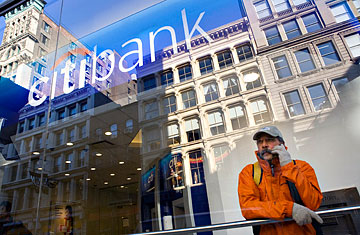
Paul Havard talks on his cell phone inside a Citibank branch in New York on Jan. 16, 2009
(5 of 5)
Regulators are split on what to do next. The Federal Deposit Insurance Corporation is backing a plan to create what it calls an aggregator bank, which would buy up the loans of BofA, Citigroup and the rest of our now troubled system, theoretically putting an end to the escalating losses eating away at the banks' capital. But if the government buys those assets at current market rates, banks would be forced to take immediate losses on the sales, doing more harm than if the government had just left the troubled loans where they are. Sources say the Federal Reserve would prefer to let the banks keep the loans and troubled bonds for now and instead provide the banks with insurance policies guaranteeing that the government will swallow a good deal of future credit losses. But a similar deal that the Fed struck with Citi did little to boost that company's stock or stave off fears that it may soon go under.
That's why a small but growing number of people are starting to talk about nationalization. Speaker of the House Nancy Pelosi recently said nationalization, or something close to it, is a better solution than just buying bad assets, because if the government takeovers succeed, then taxpayers get to keep the profits when they eventually resell the banks. But if the government doesn't turn a nationalized bank around, it could be very costly to taxpayers.
No matter what happens, things have definitely changed for Lewis and other former titans of the banking business. A few months ago, BofA's CEO was hailed for running a bank so prosperous that it was able to swallow mortgage lender Countrywide Financial and investment bank Merrill Lynch in the depths of the worst banking crisis in recent history. The trade magazine American Banker named Lewis Banker of the Year in December. Now he's fighting just to keep his job. And even if he does, he's got a new partner. The government already has a large stake in his bank, with its $45 billion in preferred shares. The government's ownership could dramatically rise if the Fed starts buying common shares of BofA, which in turn would mean that Washington would be calling more and more of the shots. Increasingly, the only shareholder that matters to Bank of America and other banks is Uncle Sam. Without the government, the math of the banking business these days just doesn't add up.