

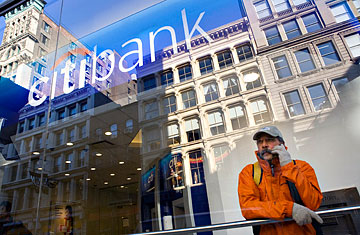
Paul Havard talks on his cell phone inside a Citibank branch in New York on Jan. 16, 2009
(3 of 5)
And to the delight of investors, BofA was pushing for the freedom to make risky loans at the same time it was aggressively repurchasing shares. Since 1998, it has spent $62 billion on share buybacks, according to S&P. The result is that over the past decade, BofA's tangible-capital ratio--the amount of tangible equity in relation to tangible assets--has nearly halved from 5% in 1998 to 2.8% in the third quarter of 2008. It became a bank built on air.
But BofA wasn't alone. By early 2008, nearly all the big banks were poorly positioned to weather a downturn--particularly this downturn. Accounting rules demand that banks take a hit to their earnings by the value of a loan when it becomes clear a borrower is not going to pay it back. When a bank's loan losses are bigger than its income, it has to take money from its shareholders' equity account to make up the difference. That's a big deal for a company's investors. If shareholders' equity is wiped out, their stock is effectively worthless. So investors watch this account intensely; if they think shareholders' equity is headed to zero, so too is a bank's stock.
FBR's Miller looked at eight of the largest financial firms in the U.S. and determined that on average, if just 3.4% of their loans go unpaid, their shareholders will be wiped out. The good news is that these firms are so large that 3% of their loan portfolio is a really big number: some $400 billion. The timing of when the loans go bad matters too. If, say, 5% of a bank's loans go bad over 10 years, the bank will survive. It can cover the loan losses with the earnings it gets from all its paying customers. But given the way banks capitalize themselves these days, if 5% of a bank's loan portfolio goes bad in a single year, the bank is toast.
The switch to doing more lending through investment-banking operations has only made matters worse. For deposit-based loans, the banks have wide discretion as to when they record a loss. Some do it after a borrower misses his first payment. Other banks wait until the loan is 120 days past due. But for loans made through a firm's investment-banking division, the bank has to reduce the value of those debts according to what similar pools of loans are worth. This is known as mark-to-market accounting. And when, as they are now, investors grow increasingly nervous that borrowers will not pay back their debts, the bonds on which those loans are based plummet in value, even before payments stop coming in. As a result, banks are watching their capital bases erode much faster than their executives ever expected--and probably faster than they can handle.
Building a Better Bailout
Tarp does nothing to patch the hole in the banking system. And it certainly doesn't do anything to encourage banks to make more loans. Yes, banks have gotten nearly $300 billion in money from the government, and that's a lot of dough. But it's not free dough. In return for federal cash, the government has taken preferred-stock shares as the firm's markers. Unlike common stock, which is the kind you or I would buy from a broker, preferreds have to eventually be paid back, so these are really loans, not additional capital.