

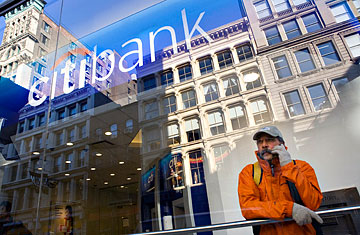
Paul Havard talks on his cell phone inside a Citibank branch in New York on Jan. 16, 2009
(2 of 5)
To understand why nationalization may be inevitable, you have to get a handle on the true source of the banks' problems. The banking business--at least the way George Bailey practiced it in It's a Wonderful Life--was all about deposits and loans. You take in deposits, on which you pay a relatively low interest rate, say 2%. Then you lend that money to other people at a higher interest rate, say 7%. Pocket the difference. Repeat. But starting in the early 1970s, banks began funding less and less of their lending with old-fashioned deposits. Bank deposits backed 90% of all loans four decades ago. Today it is 60%. Where does the rest of the loan money come from? From the bank's past earnings and the money given to it by its investors. Using the house's money has generated higher profits--and significantly higher risks.
Regulators have long had a lower capital requirement on loans that are not backed by deposits. But in 2004, the Securities and Exchange Commission (SEC) removed rules that capped leverage at 15 to 1 for investment-banking firms like Goldman Sachs. That allowed the firms to vastly expand their lending activities without raising a single new dollar of capital. One big backer of the rule change was reportedly former Treasury Secretary Henry Paulson, who was then Goldman's CEO. By that time, the regulatory separation between investment banks and traditional banks had long been removed. So traditional banks such as Citigroup and Bank of America shifted more and more of their lending operations to their investment-banking divisions, and leverage took off. By the end of 2007, many banks were lending $30 for every dollar they had in the vault. "Changing the net-capital rule was an unfortunate misjudgment by the SEC," says former SEC official Lee Pickard. "It's one of the leading contributors to the current financial crisis."
Another way banks sought to boost their profits--at least those available to shareholders--was through stock buybacks. Investors cheer buybacks because they shrink the number of outstanding shares, boosting a company's profits per share and usually its stock price. But corporate stock purchases also decrease banks' capital, because their earnings are used to purchase shares rather than retained as cash. Worse, sometimes banks borrow money in order to buy back shares, upping their leverage and lowering their capital at the same time. In the past four years alone, the nation's largest banks, as defined by Standard & Poor's, have spent $300 billion buying back stock.
One of the firms leading the charge to capital-light banking was Bank of America. Starting in 1993, a predecessor firm became one of the first banks to develop and embrace computer models that were supposed to improve a bank's ability to determine the risk of a particular type of loan. After a merger in 1998 that formed the bank, BofA officials often argued to investors and regulators that these new advanced risk controls meant the bank needed to carry less capital per loan. And BofA officials frequently fought regulations that would boost capital requirements for them and other banks. In 1998, BofA argued that tying capital requirements to credit ratings, which would have required banks to hold more funds in the vault to account for the riskiness of subprime loans, was silly.