

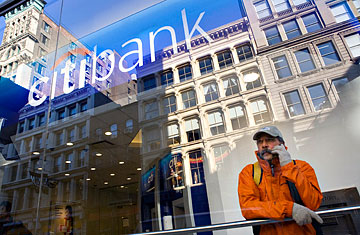
Paul Havard talks on his cell phone inside a Citibank branch in New York on Jan. 16, 2009
(4 of 5)
Say a bank has $5 in capital and $100 in loans. Now the government gives the bank an additional $5 in preferred shares and says, Go make more loans. Well, the bank might then have $200 in loans, but it still has only $5 in common shareholders' equity. The result: if just 2.5% of its loans go bad, the bank's shareholders are wiped out. Wisely, the largest banks in the nation lent less in the fourth quarter of 2008 than in the previous three months--a strategy that has drawn some complaints. But that hasn't removed the pressure on their shares. That's because the banks have had to continue to take loan losses. And banks don't have the option to pass those losses off on the new money they got from the government. They have to write down their common stockholders' equity first. And as that capital falls, so too do the bank's shares. Some are alarmingly close to zero.
No bank's stock has fallen more in value during the past four months than Bank of America's. The combined value of its shares is now $37 billion. That's $123 billion less than they were worth at the end of September. In the third quarter, BofA was forced to write down $4.4 billion in loans, or about 1.8% of its loan portfolio. Compared with what some of its competitors wrote down, that wasn't a heck of a lot; Citigroup, for instance, had a $13.2 billion charge in the same quarter, primarily related to loan losses. But the relatively small loss took BofA's thin tangible equity, the type of capital that matters most to shareholders, down to a ratio of just 2.6% of loans, according to FBR. By that measure, Bank of America was a weaker bank than any of its rivals, including Citigroup. But since the market was so focused on bad loans and the charge-offs banks had to take, no one seemed to notice BofA's faults.
That is, until the fourth quarter. In mid-September 2008, in a deal pushed by regulators, BofA agreed to buy Merrill Lynch. The acquisition actually boosted BofA's capital ratios, but it also added losses to an already fragile capital structure; Merrill Lynch lost $15 billion in the fourth quarter alone. Knowledge of the impending losses forced BofA CEO Ken Lewis to ask the government for an additional $20 billion in TARP funds--on top of the $25 billion it had already received--as well as about $100 billion in loan guarantees. Without the government assistance, BofA says, it couldn't have closed the merger.
The Merrill losses, which weren't publicly revealed until early January, have angered shareholders, some of whom have sued the company for not informing them sooner. And two weeks ago, the losses also led Lewis to ask Merrill's top executive, John Thain, to resign for failing to keep BofA officials apprised of his firm's bottom-line problems. Thain says Lewis knew all along.
Cleaning Up the Mess
Nouriel Roubini, The New York University economics professor who was famously early in predicting that the end of the housing boom would cause a financial crisis, estimates that continued loan losses will force U.S. banks to come up with an additional $1.4 trillion just to stave off bankruptcy. And since the banks aren't likely to earn much money or attract new investors anytime soon, much of the money will have to come from the government.