

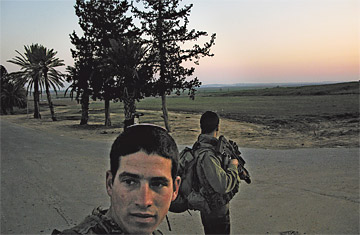
Soldiers on patrol at Kibbutz Nir Am, a mile from Gaza. Even after the start of Israel's Jan. 4 ground offensive, communities near the border remained vulnerable to Hamas' rockets.
(4 of 5)
Even in a dangerous neighborhood, it is possible to imagine that, secure in its military power, Israel could continue for years in a state of neither all-out war nor true peace, always willing to fight bitter but limited conflicts of the kind it did in Lebanon and Gaza. But military might would be useless against the threat that looms within its borders. Israel's population of 7.1 million is today divided into 5.4 million Jews and 1.6 million Arabs. But if you include Arabs in Gaza and the West Bank, they may already have a slender majority; and given their higher birthrate, the gap will widen quickly. This tectonic shift in demographics is what scared even hawkish Israelis like former Prime Minister Ariel Sharon into abandoning the biblical dreams of a Greater Israel stretching all the way from the Jordan River to the Mediterranean. As Olmert recently warned, "If we are determined to preserve the Jewish and democratic character of the state of Israel, we must inevitably relinquish, with great pain, parts of our homeland." In other words, if Israelis cling to the West Bank and Gaza, as many religious Zionists insist, Jews will find themselves a shrinking minority in their own state.
Not only would Israel cease to be a Jewish state, it would no longer be a democratic one either, unless Arabs are given a fair share of power. A few bold Arab intellectuals are saying Palestinians should abandon the idea of a two-state solution and just wait until they outnumber the Jews. That would take decades, and it may rest more on wishful thinking by Palestinians than a real calculation of political reality. But the population shift underscores a plain fact: for Israel, the status quo won't be good enough for much longer.
A Road Map for Survival
The path to a workable peace, one with a Palestinian state alongside Israel and both with internationally recognized borders, has long been well known. A succession of Israeli and Palestinian leaders have been reluctant to take it. Israelis have doubted that they had a partner who could deliver them peace; aside from being plagued by disunity, the Palestinians have been unwilling to modify their demands that Palestinian refugees be allowed to return to their ancient homes inside Israel, which Israel will never accept. With a general election looming in Israel--polls suggest that the hawkish Benjamin Netanyahu is likely to become the next Prime Minister--there is an opportunity to start talking again.
Israel's leaders need to recognize that if Hamas cannot be beaten militarily, then it must be engaged politically. That means accepting the idea of dealing with some kind of Palestinian unity government that includes Hamas. A coalition between Hamas and Abbas is essential for the future of a Palestinian state and for moderating Hamas' extremism. Hamas, which 18 months ago chased Abbas' men from Gaza, says it will pair up with Abbas if he, along with the international community, recognizes that the Islamic militants legitimately came to power in the January 2006 elections. Israelis rightly view such claims with skepticism, and yet all Palestinians and their Arab backers reject the current situation, where the meager land set aside for a future state is chopped into two, Gaza and the West Bank, ruled by rivals.