

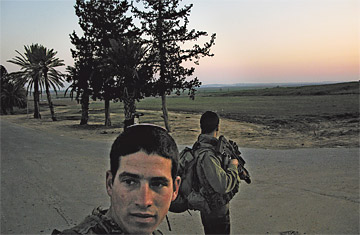
Soldiers on patrol at Kibbutz Nir Am, a mile from Gaza. Even after the start of Israel's Jan. 4 ground offensive, communities near the border remained vulnerable to Hamas' rockets.
As Israeli troops encircle Gaza City, their commanders are faced with a painful dilemma: How far must they advance into the deadly labyrinth of slums and refugee camps where Hamas militants await with booby-trapped houses and snipers? With each passing day, Israel's war against Hamas grows riskier and more punishing, with the gains appearing to diminish compared to the spiraling costs--to Israel's moral stature, to the lives of Palestinian civilians and to the world's hopes that an ancient conflict can ever be resolved. Ideally, in a war shaped by television images, Israelis would like a tableau of surrender: grimy Hamas commanders crawling from underground bunkers with their hands up. Instead, the deaths of at least 40 civilians taking shelter at a United Nations--run school north of Gaza City are more likely to become the dominant image of the war. Israeli politicians and generals know that the total elimination of Hamas' entrenched military command could take weeks; it might be altogether impossible. The more realistic outcome is an unsatisfactory, brokered truce that leaves Hamas wounded but alive and able to regenerate--and Israel only temporarily safe from attack.
Israel's Defense Minister, Ehud Barak, has promised a "war to the bitter end." But after 60 years of struggle to defend their existence against foreign threats and enemies within, many Israelis may be wondering, Where does that end lie? The threat posed by Hamas is only the most immediate of the many interlocking challenges facing Israel, some of which cast dark shadows over the long-term viability of a democratic Jewish state. The offensive in Gaza may degrade Hamas' ability to menace southern Israel with rocket fire, but, as with Israel's 2006 war against Hizballah, the application of force won't extinguish the militants' ideological fervor. The anti-Israeli anger swelling in the region has made it more difficult for Arab governments to join Israel in its efforts to deal with Iran, the patron of both Hamas and Hizballah and a state whose leaders have sworn to eliminate Israel and appear determined to acquire nuclear weapons.
Just as ominous for many Israelis is a ticking demographic time bomb: the likelihood that Arabs will vastly outnumber Jews in the land stretching from the Jordan River to the Mediterranean is a catastrophic prospect for a nation that defines itself by its faith. At some point, Israelis will have to choose between living with an independent Palestinian state or watching Jews become a minority in their own land.