

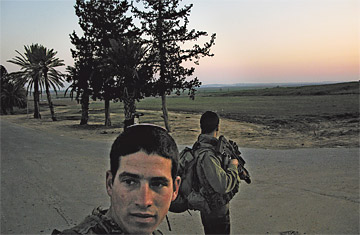
Soldiers on patrol at Kibbutz Nir Am, a mile from Gaza. Even after the start of Israel's Jan. 4 ground offensive, communities near the border remained vulnerable to Hamas' rockets.
(2 of 5)
As much as any other nation on earth, Israel is based on a dream: the aspiration to establish a home for the Jews in the birthplace of their ancestors. To a remarkable extent, that dream has been fulfilled, as Israel has grown into the most modern and democratic country in the Middle East and a dependable American ally. A strong, confident Israel is in America's interest, but so is one that can find peace with its neighbors, cooperate with the Arabs to contain common threats and, most important, reach a just and lasting solution with the Palestinians. But accomplishing all that will require Israel and its defenders to confront excruciating dilemmas: How do you make peace with those who don't seem to want it? How do you win a war when the other side believes time is on its side? And what would true security, in a hostile neighborhood populated with enemies, actually look like? As is always true in the Middle East, there are no easy answers. But it's never been more vital that Israel start looking for them.
How to Deal with Hamas
The most immediate challenge facing Israel is that posed by Hamas. Gaza's tragedy has for days been playing out on the world's TV sets. By Jan. 7, more than 700 Palestinians, many of them noncombatants, had been killed. But there's something tragic, too, in Israel's predicament: in any confrontation with its enemies, it is damned if it does and doomed if it doesn't. Across Israel's political spectrum there seems to be a consensus that Hamas' provocative rocket barrages could not go unanswered--though whether Israel's response has been proportional to the threat is, at the least, questionable.
Perhaps more threatening than the rockets themselves was the doubt they cast over Israel's vaunted power of deterrence, which is key to keeping its hostile neighbors at bay. That power was badly eroded in 2006, when Hizballah was able to withstand the Israeli onslaught, force a cease-fire and claim victory in the process. That surely emboldened Hamas, which intermittently sent rockets into southern Israel and finally prompted Israel to respond in force. As respected Israeli columnist Nahum Barnea wrote in the Hebrew daily Yedioth Ahronoth, "A country that is afraid to deal with Hamas won't be able either to deter Iran or to safeguard its interests in dealing with Syria, Egypt, Jordan and the Palestinian Authority."
But the cold reality is that eventually Israel may need to look not to "deal" with Hamas so much as do a deal with it. Prime Minister Ehud Olmert has said he doesn't intend to topple Hamas; he knows Israel can't fill the vacuum of leadership that its elimination would produce in Gaza. Neither can Mahmoud Abbas, Israel's preferred Palestinian leader, who is fading into the background in the West Bank. So Israel has said it will be satisfied if Hamas stops shooting rockets and an international force polices the Egyptian border to keep the militants from re-arming themselves with weapons smuggled through tunnels.
Hamas says it will agree to a truce if Israel retreats from Gaza and loosens the economic choke hold that has strangled the 1.5 million Palestinians who live on the sliver of land along the Mediterranean. After weeks of global outrage over the unfolding humanitarian disaster in Gaza, any mediator--France, the European Union, Turkey and Egypt are all auditioning for the role--will insist that Israel end its 18-month blockade.