

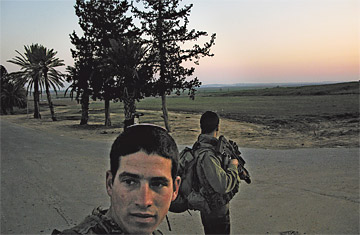
Soldiers on patrol at Kibbutz Nir Am, a mile from Gaza. Even after the start of Israel's Jan. 4 ground offensive, communities near the border remained vulnerable to Hamas' rockets.
(3 of 5)
What then? Like Hizballah, Hamas will declare itself victorious: not only will it have survived a direct assault by a far superior military force, but it will also have freed Gazans from Israeli tyranny. As an added bonus, any economic revival of Gaza would put money into Hamas' coffers. But Israel would gain some breathing space and force Hamas to prove it can actually govern and maintain stability in Gaza rather than heap blame entirely on Israel.
The Specter of Iran
One indirect objective of the Gaza offensive might have been to warn off Israel's other nonstate militant foe: Hizballah. While the Lebanese group has been cheering on Hamas from the sidelines, it has refrained from entering the fray. Hizballah may have a stockpile of new rockets, but Israeli generals hope Gaza will serve as a cautionary example of what would happen if it used them. This is a reassuring thought, but it remains to be tested. After all, Hizballah's rockets have only one purpose, and that is to be used against Israel.
The broader aim of the Gaza war, Israeli security experts argue, was to send a message to Hamas' sponsor, Iran. It's certainly true that the assault has broken the Iranian pipeline that delivered weapons and funds to the militants. But by killing hundreds of Palestinians, Israel may have undermined its hopes of forming common cause with moderate Sunni Arab states against the nuclear ambitions of Shi'ite Iran.
The Gaza offensive has greatly weakened Israel's few Arab allies. Moderate Arab countries that were edging closer to recognition of the Jewish state are now recoiling from what they see as the slaughter of fellow Arabs in Gaza. In Egypt, pro-Gaza protests turned into thinly veiled attacks on President Hosni Mubarak's rule, which has helped maintain the blockade of Gaza. The pressure may force Mubarak to support a truce that entails opening the Egypt-Gaza border as Hamas demands, but he is unlikely to soften his position on the Palestinian group that maintains links with Egyptian Islamists as well as the Iranian regime.
But how far Arab states will be willing to go now to make peace with Israel is unclear. The Saudi-sponsored Arab Peace Plan, which offered Israel peace with 22 Arab countries if it withdrew to its 1967 borders, will remain on the table for Israel's new PM to consider. Even Syria, a prime supporter of Hamas, spent part of 2008 in indirect peace talks with Israel mediated by Turkey. But Syria has broken off its talks for now, destroying any chance that Damascus, on behalf of Israel, might put pressure on the exiled Hamas leaders residing there.
Confronting the Danger Within