

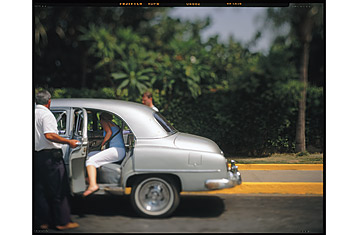
A vintage taxi picks up passengers at the Hotel Nacional. The capital city's glut of old American Bel Airs, Corsairs and Corvairs has less to do with nostalgia than with the crippling economics of the U.S. embargo
(5 of 5)
Hanry (not a misspelling--just typically improvisational Cuban nomenclature) played the tres, a sort of Cuban mash-up between a lute and a guitar, in our band. He had his chance at being a foreigner, at least temporarily. It was the end of the band's last international tour, and he was offered a rich, steady gig in Munich. He says that only loyalty to the group brought him back home. But as soon as they got back, the band absconded to Mexico. Some say Hanry started drinking after that; he says he was just disgusted with the betrayals. Whatever the backstory, Hanry, a powerful and precise player in his prime, left music altogether for a few years.
He's getting back into it now, despite the constant anxiety over money. He plays for tourists in Old Havana but earns just a few dollars a night. The strings for his instrument are made out of recycled telephone wire; he cuts his guitar picks from shampoo bottles. He is still restless, eager for an upgrade in life.
The whole island feels on a similar knife's edge. Should Raúl Castro weaken, there are still a dozen aging Ahmed Chalabis waiting in Miami to return from exile and divide the spoils among themselves. Should there be rebellion in the streets in Havana, there's still a state militancy that could bring blood to the Malecón. But the new generation of Cubans both here and abroad are of a milder bent, with gentler aspirations. A cabdriver I met launched into a familiar refrain: most of his family fled to Tampa when Fidel Castro stole their lands. So was he--or his family in Florida--waiting to take the land back, to evict those who live there now? "No," he said, "we're all tired of thinking about fighting." His younger relatives in Florida have forgotten to be angry. More and more Cubans are looking for common ground.
Late in my travels, I was on a rural highway on the way to Santa Clara, crammed in the backseat with Oscar, his wife Yusimi and their radiant daughter Zenia, 5. We'd been out late dancing a few nights earlier, and Yusimi was giving me a postmortem on my performance. (Her bemused verdict: "You have Caribbean feet, but I have no idea what your butt is doing.") Just then, "La Jinetera" by the staunchly anti-Castro Miami singer Willy Chirino came through the speakers. It must have been the driver's CD--the song would never have been allowed on state-run radio. Chirino, a Cuban-born exile, has always been a little too naked in his politics for my tastes, and this song is no different, a lament about a teenage hooker who's dismal in "a land where the future jumped the wall and swam away." But Zenia was worried about none of that. There's a particularly sweet chorus at the end of the song: "Oh Habana, oh Habana." Zenia started singing along, in the same pure voice her father has. Let the adults sweat their fevers; for her, this was a simple love letter to her city. She doesn't need a music video; her Havana already has a sound track.