

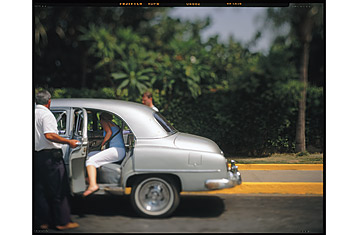
A vintage taxi picks up passengers at the Hotel Nacional. The capital city's glut of old American Bel Airs, Corsairs and Corvairs has less to do with nostalgia than with the crippling economics of the U.S. embargo
(3 of 5)
"I have nothing against reggaeton," one of my friends told me in a typical refrain. "It's just not Cuban. And it's not music." Those are strong words, and Cuban hip-hop artists would argue that their music is edgier and more political. But for indigenous, righteous, complex and complete music, there is nothing like Cuba's timba. It has been a vital outlet for taking on taboos, like Los Van Van's early critique of rampant prostitution in a 1996 song about papayas: go ahead, they sang, touch it; it's a national product. During the economic crisis following the Soviet collapse, music was the one thing that held the island together, a common passion for both revolutionaries and reactionaries. The government understood its power; that's why supergroup La Charanga Habanera was banned for months in the '90s after using a military helicopter to drop the group onstage for a stripteasing, innuendo-filled concert on national TV. It was, someone clearly decided, too decadent, too American.
The U.S. embargo, like all grand schemes that seek to upend geography and history, is a porous affair. Rural U.S. lawmakers looking for new agricultural markets have made America the No. 1 exporter of food to Cuba. Grey's Anatomy and House were among the most popular shows in Havana this summer. Those who have money (often from family in the States) are scrambling to get converters to prepare for next February's conversion to all-digital TV signals.
And Cuba is cracking up from the inside. I came here to find the band, but not only did it split up (Oscar joined Los Reyes long after leaving El Septeto), but most of its members don't even live in Cuba anymore. Jorge and Piri, who played bass and drums, live near Cancún. They've got a regular gig at a Cuban-themed bar; Jorge married the bleached-blond singer who fronts the band, which now calls itself La Barbie de la Salsa. George works in Mexico City as a producer and guitarist with Margarita Vargas Gaviria, known throughout Mexico as the Goddess of the Cumbia.
I tracked Eddy, the flute player, to an apartment in Guadalajara, Mexico's second largest city. He hasn't seen his family in two years. Every Tuesday he goes to the immigration office to try to get temporary visas to bring them to Mexico. But the Mexican bureaucrats keep asking for bribes. And he's not sure how his wife would even adjust--she's too communist, he says, laughing. She would miss her friends and co-workers in Cuba too much. For her part, she told me when I visited her in Santa Clara that she always knew it would be this way: marrying a Cuban musician is like marrying a soldier or a doctor, she said. They're always on call; they're always overseas.
Wary of the World
Damaris was one of the dancers who used to perform with our band--more than 40 years after the Mafia quit Havana, some Cubans still like their music accompanied by girls in slinky sequined outfits with tail feathers. Damaris and the drummer, Piri, wound up having a daughter together but eventually divorced. He moved to Mexico, found a new wife and had another child. So Damaris is raising their child alone in a small apartment in the shadow of the capitol.