

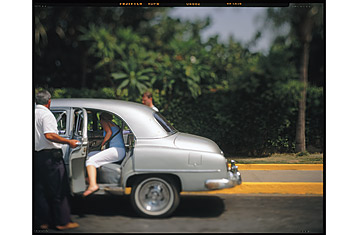
A vintage taxi picks up passengers at the Hotel Nacional. The capital city's glut of old American Bel Airs, Corsairs and Corvairs has less to do with nostalgia than with the crippling economics of the U.S. embargo
(2 of 5)
I've known Oscar Muñoz, the lead singer, for a long time. In 1999, in the middle of a short and ill-fated career as a saxophone player, I was one of a wave of American musicians who made the pilgrimage to Havana. I was a worse player than most, but luck was with me--I quickly fell in with Oscar and a traditional band called El Septeto Tipico de la Habana. I played out the summer at their regular gigs in the mansion district called Vedado, west of the old city.
What I remember from 1999 was the ubiquity of music: everywhere, every day, in clubs at night and on the Malecón in the mornings--music. At González Coro hospital in Vedado, where my wife was working for the summer, surgeons broke out a boom box in between patients and invited nurses and med students alike for an impromptu salsa session. Dance, sing, smile, repeat: the cultural cure for whatever ailed the revolution.
This outlet, though, may be in danger. Cuba is restless; increasingly, just a flick of the hips and a ready melody aren't enough. And under the surface, Cuba is already changing--it's closer than ever to the U.S. but also closer than ever to losing its cultural patrimony. President-elect Barack Obama is hoping that small moves will help open up Cuba from the inside. During the campaign, he stopped short of calling for an end to the embargo but pledged to make it easier for Cuban Americans to travel and send money to Cuba. But one way or the other, change is coming to Cuba, and if the island is going to preserve its identity, it will need its music more than ever. But will my friends even be there to set the drama to song?
Defending the Music
Oscar sees his current band's mission as simple: defending the Cuban sound. In 10 to 15 years, adds the bandleader Jesús, there won't be any Cuban music left on the island. It will all be in foreign countries, stagnant nostalgia acts like the kind that spun off from the Buena Vista Social Club album. That seems a dire prediction, but a Thursday night in Havana makes you wonder how Cuban music will survive. On Avenue G, the roqueros gather to get high and watch rock videos on makeshift outdoor screens. On the Malecón in front of a gas station, a band called Aria thrashes out garage rock for a small crowd outside while upstairs at the Jazz Café a saxophone player named César López heats up the stage with squealing Ornette Coleman riffs. More ominous to the salseros is the Riviera, Meyer Lansky's citadel to Vegas chic in Havana. The Cuban-music venue inside is shuttered, but in the front bar, there's house music mmph-ing loudly, and there's a line of wealthy young Cubans waiting to get inside--girls in high heels and pert dresses, guys with Kanye West shades and perfectly pressed wide collars. These smart-set Habaneros are called Mickeys because, people like to say, they live in a cartoon world.
The Mickeys may be a minority, but more and more clubs are turning to house or techno instead of live music. And radio and TV stations--all government-run--are playing less timba, the Cuban version of salsa. These are the multiple threats: rock, electronica and, the biggest danger of them all, reggaeton--the Latinized hip-hop that has infiltrated from Puerto Rico, New York City and the Dominican Republic.