

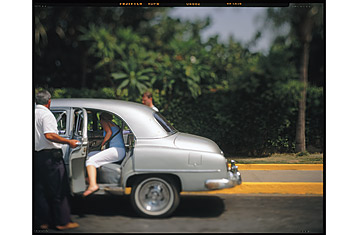
A vintage taxi picks up passengers at the Hotel Nacional. The capital city's glut of old American Bel Airs, Corsairs and Corvairs has less to do with nostalgia than with the crippling economics of the U.S. embargo
(4 of 5)
An afternoon with her is a long walk through the schizophrenia of the Cuban economy, still caught in the maw of the U.S. blockade and hampered by its own gross inefficiency. At an open-air market behind the capitol, mangoes, okra, guavas and limes are everywhere--and cheap. Good thing too because most Cubans earn from $15 to $25 a month and survive off the ration books that offer them sugar, rice, beans and (only for the elderly) cigars. But to get past subsistence, you need to shop at the air-conditioned hard-currency stores. That's where Damaris goes to find a specialized nail clipper she needs for the manicurist test she's taking the following week. But it costs nearly $20, three times what it would in the U.S. A knockoff 26-in. (65 cm) "PanaBlack" TV--one of those outdated crt behemoths--is listed at over $750. It's the result of a supply chain gone insane. Chinese influence is everywhere here--from the ubiquitous Yutong buses to the new renovations financed by the Chinese at Lenin Park on the outskirts of town and the three channels of Chinese state-run television that play in Havana hotel rooms. But unlike in the U.S., China hasn't flooded the island with cheap consumer goods--at least not cheap enough.
Back at Damaris' apartment, we sit at the table and pick stones out of the red beans she bought: the vendors put pebbles in to drive up their margins. The mix today is about one part rocks, four parts beans. Damaris shrugs. "You wake up thinking about where to get breakfast, you eat breakfast thinking about where to get lunch, and on it goes," she says. "To be Cuban is to be tired."
She says that earlier this year, 19 teenagers went missing from her neighborhood. They had made a pact to leave Cuba by raft. Months later, not one of them had called to say they had arrived in the States. The mothers in the neighborhood knew their children had drowned.
However Cuba changes, there will be difficult times with its neighbor to the north. Even before the murderous enticement of Washington's wet-foot, dry-foot policy that rewards Cubans who survive the trip across the waters with citizenship (while denying many visa requests made through proper channels in Havana)--even before Fidel Castro--relationships have been uneasy between Cuba and the U.S., which essentially colonized the island after Spain left in 1898. There was the U.S. administrator who in the early 1900s announced plans to "whiten" the population. And the 1901 Platt Amendment, which helped carve the U.S. Naval Base at Guantánamo out of Cuban territory. But Cuban outrage never extinguished the lure of the north for ordinary Cubans. And given the state of Cuba's economy, bedazzlement with the outside world is as strong as ever. A common joke: A little boy is asked in Havana what he wants to be when he grows up. He thinks for a moment before answering, I want to be a foreigner!
Common Ground