

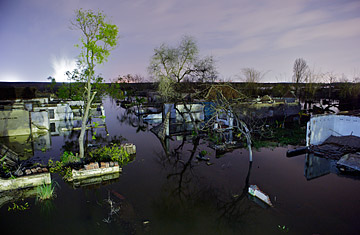
After the flood: Steam rises behind homes and businesses submerged by mud in East Java, Indonesia
(4 of 4)
Anger Management
As negotiations have dragged on, the refugees are growing increasingly militant. In one corner of the market camp, villagers have stockpiled sharpened bamboo stakes — a defense against possible forced eviction. The villagers have also directed their anger at local officials regarded as allies of the company. At one recent protest, a crowd of about 200 people occupied a government compound to demand the resignation of a village chief. The demonstration began almost casually, with families picnicking or resting beneath the shade of a banyan tree. But tempers rose with the broiling midday heat. A squad of policemen armed with machine guns arrived and took up a position opposite the protesters. "Please respect our suffering," a man shouted through a loudspeaker. A scuffle broke out between police and protesters, and the policemen surged forward, kicking and pushing the scattering demonstrators. One of the protest's leaders explained that the police had previously exercised restraint when dealing with them. "We carry out our protests in a peaceful manner," he said. "We never have anarchy." Then he added, for portentous effect: "Not yet." The demonstrations are indeed growing more aggressive: on Feb. 19, villagers blockaded a main road in the Sidoarjo area to protest a new parliamentary report that concludes Lusi was a natural disaster.
Fueling the refugees' anger is the fear that Lapindo will walk away from its promises. Last September, PT Energi Mega Persada, a company controlling 50% of the Lapindo drilling project and connected to Bakrie, the Indonesian Cabinet minister, attempted to unload Lapindo for $2 to a company based on the island of Jersey but owned by Bakrie's family conglomerate. When Indonesian financial regulators blocked that sale, Energi Mega tried to sell half the beleaguered Lapindo to the Freehold Group, registered in the British Virgin Islands. That deal also collapsed amid controversy. The attempted corporate reshuffling raised fears among many that Lapindo was preparing to declare bankruptcy, thus potentially allowing parent company Energi Mega Persada to evade any liability for Lusi. Lapindo says it is committed to compensating Lusi's victims.
Critics say the government's own response to the disaster has been muddy at best. "The government is not serious in its handling of the disposal of the mud or settling the social problems caused by the disaster," says Sonny Keraf, Indonesia's former Environment Minister and head of a parliamentary investigation into Lusi. "They are leaving the people to face the company when it should be acting as a bridge between them." Keraf says that, while he believes Lapindo is acting in good faith, the government's indecisiveness is blunting any sense of urgency. A yearlong police investigation into the eruption has resulted in no indictments or clear conclusions. "It's all about politics," says Ivan Valentina Ageung, head of legal affairs for the environmental group Walhi, referring to the disaster in general. Walhi sued Lapindo, alleging it was responsible for Lusi; that, as well as another lawsuit, were decided in favor of Lapindo. A spokesman for Yudhoyono denies that Bakrie's connection to the administration has influenced the government's response. Indeed, it was Yudhoyono who ordered Lapindo to compensate the displaced villagers.
But cleaning up Lusi's mess won't be easy. In a worrying sign, heavy rains in early January caused a breach in the levees, forcing more than a hundred families to evacuate. With the government's attempts to stop or channel the mud faltering, and the tide rising by the day, the sludge that swallowed Porong could eventually threaten another quarter-million homes. Indonesia's Big Hole only gets deeper.