

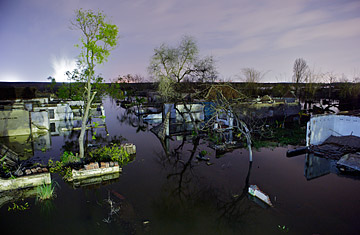
After the flood: Steam rises behind homes and businesses submerged by mud in East Java, Indonesia
(2 of 4)
Ground Forces
Indonesia is both blessed and cursed by geology. Volcanic ash contributes to the archipelago's fecund soil. Yet eruptions periodically kill thousands. Indonesia is also rich in minerals and oil, exporting nearly half a million barrels a day. All told, the country's buried wealth accounts for almost 30% of its total exports. But the same grinding geologic processes that make this wealth possible also bedevil Indonesia with disasters like the 2004 earthquake and tsunami that killed more than 160,000 people in Sumatra. Lusi is unlike any previous disaster, however. Unfolding in implacable slow motion, it has confounded Indonesian engineers and mystics alike. The mostly poor villagers who have lost homes and livelihoods to the mud complain that the response to the unfolding disaster has been equally sluggardly — a symptom, perhaps, of the fault lines in Indonesian society's own unsettled foundations.
That's because mud isn't the only thing boiling over in Porong. Villagers displaced by the eruption blame the disaster on PT Lapindo Brantas, an Indonesian mining company drilling for natural gas in the area. Lapindo is partly controlled by the family of Aburizal Bakrie, Coordinating Minister for the People's Welfare, one of Indonesia's wealthiest men and an ally of President Susilo Bambang Yudhoyono. Victims of the disaster say that a murky web of political influence and corporate fecklessness has blunted the official response to the mud eruption. "Everyone is suspicious," says Mas Achmad Santosa, one of Indonesia's most prominent environmental lawyers. "It's a politically heavy case."
Some independent geologists, including Davies, believe that Lapindo may have inadvertently roused the awesome force slumbering beneath Indonesia. "I'm 98% certain this was due to drilling," he says. Davies, who visited Porong last year and has studied the eruption extensively, thinks he knows how that happened. On May 27, Lapindo's Banjar Panji-1 well was operating in a field not far from Ahmad Mudakir's village. The well's target was a shelf of limestone some 9,800 ft. (3,000 m) below the surface. Lapindo's drillers were searching for natural-gas deposits, but the well was exploratory. No one knew for certain the subterranean conditions beneath Porong. The drillers had reached about 9,300 ft. (2,800 m) when they noticed a drop in pressure inside the well.
Such a drop, called a loss of circulation, isn't uncommon in gas drilling. It usually means that natural fractures inside the borehole are allowing drilling fluid to leak out. Lapindo's engineers responded by pumping heavy drilling mud into the well to seal the cracks and restore pressure. Then they began to pull out the drill. Davies thinks that while they were removing the drill on the morning of May 28, they set off a massive "kick," in which high-pressure water and gas from the surrounding rock flowed into, rather than out of, the borehole. To prevent a potentially dangerous blowout, the drillers shut vents at the surface, effectively corking the pressure inside the well. But it was too late. Water from a pressurized aquifer thousands of feet below the surface surged upward, picking up debris from a layer of mudstone as it did. Davies compares the effect to a bicycle pump. When the pump is sealed, the pressure is contained inside. But when it is allowed to escape, air comes rushing out. Lapindo's drilling primed a natural pump, he believes. Unable to escape through the capped well, the water sought other avenues. At around 5 a.m. the following morning, the first eruption started in a rice paddy about 500 ft. (150 m) from the Banjar Panji-1 rig.
Banjar Panji-1 never should have gotten so out of control, according to Richard Swarbrick, a British expert on geological pressure and a consultant to oil companies. Usually, when drilling in geologically unstable areas, engineers install steel casing at greater depths, where the low density of the rock might allow fluid to escape from the borehole. In the event of a kick, the casing allows drillers to maintain the integrity of the well. Swarbrick, who has reviewed Lapindo's drilling plan, says the company originally intended to install casing at depths of 3,500 ft., 4,500 ft. and 8,500 ft. (1,000 m, 1,400 m and 2,600 m). "The conventional well design in that sort of pressure environment would be to install casing," Swarbrick says. Yet, either through oversight or because of technical problems, Lapindo did not case the hole to the planned depth. "For whatever reason, they weren't following the plan," Swarbrick says. "They had 5,000 feet of open hole. That's taking one heck of a risk."