

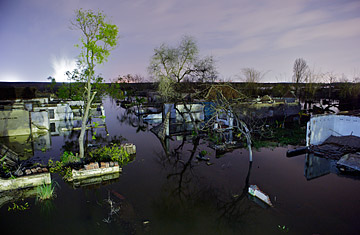
After the flood: Steam rises behind homes and businesses submerged by mud in East Java, Indonesia
(3 of 4)
The Nature Argument
Lapindo says its drilling plan was approved by the government. "The drilling process complied with mandatory regulations," says company vice president Yuniwati Teryana. "We met the requirements." Teryana offers another explanation for the eruption. Two days before Lusi started, a 6.3-magnitude earthquake shook the city of Yogyakarta, about 190 miles (300 km) to the west of Porong. Lapindo believes that the quake opened natural fractures that allowed the mud to escape. "The mud eruption is caused by a natural phenomenon," Teryana says. That's an opinion shared by Adriano Mazzini, a geologist at the University of Oslo. After studying data provided by Lapindo, Mazzini concluded that Lusi was probably caused by the May 27 earthquake. "There is strong evidence for a naturally triggered event," he says. Davies believes that if the eruption had been caused by the quake, it would have occurred sooner afterward; he cites research suggesting Porong was too far from the earthquake's epicenter to be affected.
Given that no one fully understands the powerful subterranean engine powering Lusi, efforts to stop it have proven predictably ineffectual. Two relief wells intended to reduce pressure inside the original well have failed. Early last year, scientists from Indonesia's Bandung Institute of Technology came up with a more novel idea: dropping thousands of concrete balls, linked with chains like a string of pearls, into the Big Hole. The idea was to bleed off pressure inside the volcano slowly enough so that Lusi wouldn't simply erupt elsewhere — or shoot the concrete balls back out like a cannon. Satria Bijaksana, one of the Bandung scientists who came up with the idea, says that the balls reduced the mud's flow temporarily. But the project was abandoned last March when a new government team took over management of the site. More recently, a Japanese team proposed building a 130-ft.-high (40 m high) dam to contain the mud. Scientists familiar with Lusi have dismissed that idea. Because the ground beneath the caldera is still sinking, a heavy concrete dam would likely rupture.
Going with the Flow"]
Lusi may, in fact, be unstoppable. In 1979, the oil company Shell set off a similar eruption while drilling off the shore of Brunei. That mudflow took 20 years and 20 relief wells to halt, according to Mark Tingay, a geologist at the University of Adelaide in Australia. Lusi may eventually choke itself as mud clogs its interior plumbing. But if left to die on its own, Davies estimates that it could continue to erupt for years, and perhaps even decades. Hardi Prasetyo, deputy head of the new government team in charge of Lusi, says that his workers are now focusing on containing, rather than stopping, the mud. The current strategy includes channeling the sludge into the nearby Porong River in the hope that it will be flushed to the sea. Mud flows through a massive spillway to a pumping station, from which it gushes into the river. Two dredges work to keep the waterway open. But already, the river is filling with mud. At a shrimp farm downstream, where men stripped to their underpants wade through paddies, workers complain that the mud is clogging their water supply. "This is a war," says Prasetyo, gesturing at a line of trucks rumbling along a levee. "We are not promising to stop it. We must also pray to God."
Locals have turned to less orthodox methods. According to one popular story, the Lapindo drilling may have angered a spirit living in a tree near the eruption site. Such beliefs have an enduring appeal in this part of Indonesia, where religion is a syncretic mix of Islam and animism, and Lusi has drawn mystics from Bali and Borneo, who have sacrificed chickens, monkeys and even a cow to mollify the upset spirit. The government's engineering team has tried similar tactics; a spokesman says the group has hired diviners to pray for rain to wash the mud away.
Along with the mystics have come opportunists. To attract curious visitors, one enterprising local hotel changed its name to Kuala Lumpur: "Lake of Mud." In the roads near Lusi, shirtless men dart in and out of traffic selling bags of roasted nuts and dried fruit. They have also installed themselves at certain busy intersections, and demand a small levy to let cars pass. At the top of a levee, the men eagerly tout CDs compiled from video footage of the disaster. "Professional best," promises one CD featuring a photo of a charred, mud-crusted corpse on its front cover. Some of the CD sellers are displaced villagers; others are merely hoping to make a little money. One man cheerfully says he is a pickpocket. For 10,000 rupiah, or about one dollar, the touts offer visitors motorbike tours of the site. One, a laconic, mostly toothless man named Purwanto, says he was a farmer before the mud smothered his rice fields. He now makes extra cash taking tourists to the wreckage of his house, located in the shadow of the levees. Purwanto's village flooded last year when the dikes broke, and, although it hasn't been fully inundated yet, most of the people have demolished their homes for scrap and moved on. At present, the village looks like it has been carpet-bombed, with piles of rubble rising out of the greasy water. Purwanto points out an especially large mound: the remains of the town's grandest house. His own more modest home is gone except for the broken stubble of the walls. "I was born at this house," Purwanto says, sucking contemplatively on a clove-scented cigarette. From a nearby mosque, still being used despite the rising mud, the call of the muezzin echoes through the abandoned village. "Where my parents are buried is covered by the mud," Purwanto adds.
There's no question about whom the villagers blame for their distress. At a refugee camp in a local outdoor market, where more than 2,000 people live in converted, tarp-covered stalls amid goats grazing contentedly on piles of garbage, graffiti makes their target clear: "Lapindo terrorist," one reads. The company provides food for everyone in the camp, along with services such as a medical clinic and a makeshift mosque. But the villagers are quick to recite a litany of complaints, from the quality of the rations to the health effects of the mud (though the government team says the gas coming from Lusi has no ill effect, locals complain of difficulty breathing and strange rashes). Mostly, though, they complain about money. On the orders of the Indonesian government, Lapindo has agreed to compensate the villagers with a total of $412 million — the company is offering 20% of the money up front, with the balance paid within two years. "It will not be enough," says Riati, a 45-year-old woman sitting outside the 16-ft.-wide (5 m wide) cubicle where she lives with her husband and sister. Riati says she turned down Lapindo's offer of 40 million rupiah, or about $4,500 — with an initial payment of 8 million rupiah — because she says even the full amount is not enough for her to buy a new home. Teryana, the Lapindo vice president, says the company hopes the holdout villagers can be persuaded to accept the compensation scheme.